

A Bonfire in the Long Night
— Cloverleaf and the Testimony of China’s Intellectual Exiles
Ren Jingjing(任晶晶)
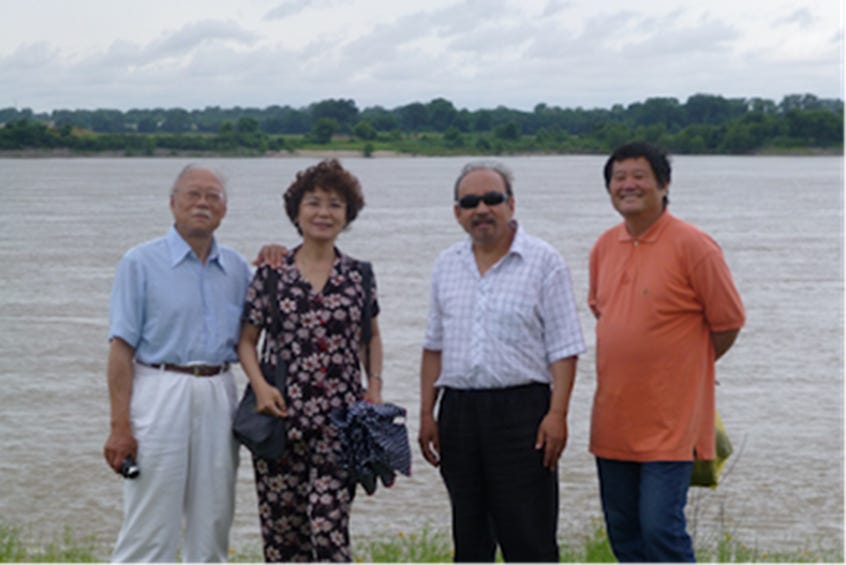
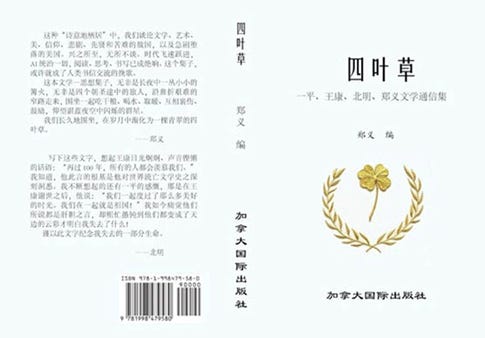
This collection of letters called Cloverleaf (《四叶草》) is itself a kind of metaphor. In the preface, Zheng Yi(郑义) explains: three-leaf clovers stand for hope, faith, and love, while the rare four-leaf clover has one extra leaf called “luck.” He sees himself, Yi Ping(一平), Wang Kang(王康), and Bei Ming(北明)as such a “cloverleaf”: surviving in an “enclave” outside the official history of contemporary Chinese literature, spared, in his words, by fortune in the narrow space between exile and oblivion. But the real “luck” of this book is that twenty years of their correspondence survived at all.
What looks, at first glance, like a pile of rambling emails and letters—what Zheng calls “hurried drafts,” neither polished essays nor carefully composed belles lettres, just “plain and straightforward exchanges” among friends—turns out to preserve something literature usually erases. Not the finished product, but the process: how an entire generation thought about literature, history, and faith while living in exile.
Four “Marginal Figures”: Forgotten Coordinates of Contemporary Literature
From the table of contents and the surviving letters, it is clear that this correspondence runs from 2004 all the way to 2024. In their letters, Yi Ping, Wang Kang, Zheng Yi, and Bei Ming talk about Russian émigré literature, about Solzhenitsyn, about Auschwitz, about the Chinese revolution, about the cannibalism of the Cultural Revolution, about Republican-era thinkers, about Chiang Kai-shek, about Tolstoy. They also talk about the decay of American politics, the war in Ukraine, and the spiritual crisis of the AI age.
The book is at once an epistolary history of ideas and a fragmentary history of Chinese exile literature in the Chinese language. In the preface, Zheng Yi calls all four of them “marginal figures.” Aside from the modest name recognition Wang Kang gained after his giant anti-Japanese War painting The Long Flow of Heroic Spirit (《浩气长流》) was exhibited in Taipei and the United States, the other three have, as he says, “been forgotten by the literary world and its readers after half a lifetime in exile.”
Yet, viewed along the longer arc of contemporary Chinese literature, these four men stand precisely at a few coordinates that mainstream literary histories have flattened.
Yi Ping is an important poet of the “thaw” years of the 1970s and 1980s. After 1989, he lost his teaching post for political reasons, went from China to Russia, then to Poland, and eventually to the United States, settling in Ithaca. His major works—written in Poland, Ithaca, and beyond—range from the long poem “Auschwitz, Spring and Easter” (《奥斯维辛、春天和复活节》), to The Thorn Birds (《荆棘鸟》), to Seven Iliad Poems (《伊利亚特诗七首》), and the unfinished epic Hailibu (《海力布》). In these works, the concentration camp, Russia’s tradition of suffering, the Homeric epic, and the inheritance of Chinese poetry are plaited together.
In the letters, Yi is not only a poet but also a theorist. He asks whether poetry is still possible after Auschwitz; he writes about the violence and religiosity in the Russian national character; he argues that “beauty is the symbol of freedom”; he wrestles with how a Chinese epic might accommodate the figure or form of “God.”
Zheng Yi begins as a realist writer of the Maple (《枫》), Remote Village (《远村》), and Old Well (《老井》) generation, then moves toward a far heavier form of “witness literature.” While in hiding inside China, he wrote Part of the History (《历史的一部分》) and Red Monument (《红色纪念碑》), documenting both June Fourth and the Cultural Revolution’s cannibalism. In exile he went on to write the novel The Sacred Tree (《神树》) and the ecological alarm bell The Devastation of China (《中国之毁灭》).
In the letters, we see him in the thick of composing a vast “river-epic”: asking Yi Ping and Wang Kang about characters’ fates, narrative structure, tragic spirit; debating possible titles; and struggling with what it means to write an epic “worthy of the mountains and rivers” in Chinese.
Wang Kang appears as an independent thinker and critic. His long essay Russia: An Apocalypse (《俄罗斯启示录》) is a recurring touchstone in the correspondence. In her very first letter, Bei Ming recommends it in solemn terms, calling it a “peerless work” and saying that “exile literature is one of the oldest motifs in world literature.” The essay, she notes, shows how Russian émigré writing carries on its national tradition while transcending European nihilism and decadence.
Wang himself organized and created the vast anti-Japanese War painting scroll The Long Flow of Heroic Spirit, and in his late years, poor and ill in the United States, he still tried to complete the huge oil painting Trial of the Ghosts (《审判幽灵》), his reckoning with the history of Communism as a global movement. In these letters he appears now as critic, now as “great painter,” and now as an old man crushed by illness and exile—yet always driven by the urge to cast suffering into “monuments.”
Bei Ming is the one closest to a “medium.” As a journalist and host at Radio Free Asia, she anchored programs like Washington Notes (《华盛顿手记》) and Bei Ming’s Uncommon Sense (《北明非常识》). In the correspondence she is also a recorder and thinker. At the outset she bluntly names two missing resources in contemporary Chinese literature: first, the severed link to the nation’s own deep humanitarian tradition; and second, thanks to information control, only scattered, fragmentary knowledge of Western literary traditions—never enough to build a real frame of reference.
For her, a text like Russia: An Apocalypse is “a masterpiece” and, in a sense, a belated textbook: something that helps Chinese-language writers locate themselves within world literature.
Seen against the map of contemporary literature, the four of them open onto a visible fault line. Official histories often package the “scar” and “reflection” literature of the 1980s as part of a reform narrative, then quietly remove the more politically charged, post-1989 and exile writings from the picture. Cloverleaf lets readers glimpse a different “underground river”: one that flows from the thaw of the late 1970s, through 1989 and exile, into today’s world of post-totalitarianism, post-Cold War politics, and a Western crisis of the liberal center-left.
Literary Correspondence: Between “Epic” and “Witness”
The most visible thread in this correspondence is the ongoing discussion of a large epic novel that Zheng Yi is writing. The letters are full of references to “Volume One,” “Volume Two,” “Volume Three,” “Volume Four,” to debates over specific battles and episodes, character development, landscape description, possible titles, and to the question “whether the inner spirit of epic is praise.”
This is not the usual exchange of blurbs and polite praise between writers. Their criticism of each other’s work can be strikingly sharp and concrete. When they discuss Yi Ping’s Auschwitz poem, for example, Zheng calls it “an undoubted success,” but also points out that there is too much discursive commentary and that the structure could be tightened. Yi, for his part, freely admits that his poem “only brushes the periphery” and “has no ability at all to enter the darkest center,” and he accepts that as a limit of what his own shoulders can bear.
This kind of self-dissection shows that “epic” for them is not a decorative word but a serious demand. An epic is not a big book stitched together from grand adjectives. It is a way of holding disaster and faith together in a single vision. For them an epic must satisfy several conditions: it has to span enough time to carry the fate of an age; it has to be rooted in direct experience of suffering, rather than written from the vantage point of power recounting victories; and it needs a transcendent point of support, often appearing as religious feeling or some form of “God.”
For this reason, Yi keeps returning in his letters to the question of “the form of God.” He reminds Zheng that if one wishes to write a Chinese epic, one cannot simply transplant biblical mythology. One must face China’s own concepts of Heaven, Dao, and Void, and must find a mode in which God can appear that fits the Chinese language. That concern immediately sets them apart from most contemporary realist writing that prides itself on being “free of metaphysics.”
At the same time, this correspondence is a sustained “training in witness” that lasts two decades. From Auschwitz to the Gulag, from the Russian Revolution to the Chinese Revolution, from the cannibalism of the Cultural Revolution to today’s war in Ukraine, from the memory of the War of Resistance in Chongqing to the despair of white working-class Americans, the letters never stop asking: Where does violence come from? Why does totalitarianism keep returning? What can literature actually do in the face of absolute darkness?
Yi’s long letter on “the violent spirit of Russia” has already moved beyond ordinary literary criticism into a kind of social and spiritual anatomy. Starting from Dostoevsky, he goes back to serfdom in Tsarist Russia and Stalin’s purges, then across to the Cultural Revolution’s “people’s cruelty” in China. He traces the “complicity” between totalitarian politics and popular violence, and argues that bloodshed cannot be pinned solely on “the Communist Party”; one must also confront the sediment of national history, social structure, and religious tradition.
This sort of perspective remains rare in contemporary Chinese literary criticism. A great deal of writing stops at condemning political violence or describing psychic trauma, but seldom asks deeper structural questions. Through repeated exchanges over many years, Cloverleaf slowly deepens that line of inquiry.
In the Mirror of Russian and Soviet Émigré Writers
The link between Cloverleaf and Russian or Soviet exile writers is not something readers need to infer; it is a theme explicitly and repeatedly raised inside the book. In her first letter, Bei Ming says that contemporary Chinese literature has a missing piece: an understanding of Russian émigré writing. She quotes Russia: An Apocalypse and stresses that “exile literature is one of the oldest motifs in world literature,” and that Russian writers have taken this motif particularly far.
In this sense, the four members of Cloverleaf clearly see themselves in the mirror of Russian exiles. They travel together to Solzhenitsyn’s house in Vermont and treat the trip as a “pilgrimage.” They discuss Solzhenitsyn’s works and his Harvard address at length and regard him as someone whose “pain as an exile is felt in the flesh.” Zheng constantly invokes the Bible, Homer, Tolstoy, Dostoevsky. He quotes Pasternak’s line that to “follow in the wake of the sacred narrative, even as a shabby tail-piece, is still to write a great work,” and he places his own work in that classical epic tradition.
Compared with Russian émigré writers, several parallels stand out.
First, there is the consciousness of “bearing witness.” Whether it is Solzhenitsyn writing about the Gulag, or the four Cloverleaf writers describing the Cultural Revolution, June Fourth, or ecological catastrophe, they take writing as testimony to the crimes of totalitarianism, not as a mere aesthetic exercise. This writing often carries a religious tone and stresses conscience, repentance, and redemption.
Second, there is the work of “re-building tradition.” Russian exiles in Paris, Berlin, and elsewhere relied on literary circles and small presses to sustain and develop their own tradition. In Cloverleaf, this function is performed, in part, by the letters themselves. The correspondence is full of calls to “inherit classicism,” “resist modernism,” and “return to the sources of literature.” The power of the great works, epics, and religious texts is never taken as a matter of course but constantly re-affirmed.
Third, there is the feeling of being a “lonely cluster.” In one letter, Bei Ming writes that contemporary Chinese literature cannot produce “anything decent,” and that in exile literature, “for a writer like you, if you look around, there is simply no second person.” The sentiment echoes that of many Russian émigrés who felt alone in foreign lands: cut off from readers in their own language, deprived of income, working without a literary environment, yet still writing as if their work itself were proof of existence.
Yet the differences are equally striking. Behind Russian exile literature stand the long tradition of Russian Orthodoxy, the twin cultural centers of Saint Petersburg and Moscow, and a highly developed intelligentsia with deep religious and philosophical roots. Chinese exile literature, by contrast, has once again emerged from a rupture. After 1949 came the withering and near-death of literature; after 1989 came expulsion and dispersal. Many exile writers have lacked even basic conditions for writing, let alone a stable community.
That these four writers managed to form a small circle of correspondence at all is already a rare exception. In a sense, Cloverleaf can be read as a Chinese counterpart to an imagined Notebooks of Exiles: not the work of “official writers” fostered by the system, but of people driven out and pushed to the margins, huddled along cold rivers and low hills, trying to keep a handful of Chinese words alive.
Four Sages in North America: Community and Self-Exile
If one looks back to classical China, the obvious association is the “Seven Sages of the Bamboo Grove” (竹林七贤). In the chaos of the Wei and Jin, with ritual and law collapsing, Ji Kang(嵇康), Ruan Ji(阮籍), and others formed a loose fellowship under the bamboo, using music, wine, and abstruse conversation as a way of refusing the political order.
“Cloverleaf” and the Bamboo Grove sages inhabit utterly different worlds, yet there is still a faint correspondence between them. The shared features are clear enough: in both cases there is a small circle on the margins in times of upheaval and collapse; there is a conscious decision to stand at some distance from the center of power and to sustain a different kind of spiritual order through conversations among friends; and there is a strong emphasis on the candor of individual lives, on friendship, and on aesthetic experience.
But the temper of Cloverleaf is quite unlike that of the Bamboo Grove. The Wei-Jin sages’ “pure talk” often leans toward a playful attitude, at times deliberately keeping reality at arm’s length. The Cloverleaf correspondence, by contrast, is always clenched around history and politics.
When these four write to one another, they are not in a mountain grove chatting about metaphysics. They are in an old house in Ithaca, in a small town in Virginia, by the Mississippi, at Solzhenitsyn’s home, on a Caribbean cruise ship, even in hospital rooms—juggling the difficulties of daily life while arguing about faith, revolution, war, totalitarianism, and epic.
If the Bamboo Grove is a symbol of withdrawal, Cloverleaf is a picture of “responsibility in exile.” They leave China, willingly or not, but they do not step off the stage of history. They carry their wounds with them and go on asking: How should the last hundred years of Chinese blood and fire be told? Can a modern civilization that has lost its faith still save itself? Does the Chinese language still have the strength to carry an epic?
In this sense, Cloverleaf presents a “modern exile version” of the Bamboo Grove: the bamboo replaced by an old frame house in Ithaca, by American towns and email inboxes; pure talk replaced by long letters; the wine still there, but now joined by communion, prayer, and the cross; the carefree hermit transformed into a pilgrim bearing the weight of history.
A Mirror for Overseas Intellectuals
Seen from a more practical angle, Cloverleaf offers several very direct insights into how to understand China today and the self-chosen exile of overseas intellectuals. In this sense, it is a mirror.
First, the book breaks the stereotype that exiles are “nothing but political commentators.” The four members of Cloverleaf certainly engage in politics, yet the most intense passages in their correspondence are often not their commentary on current policy but their discussions of literature, faith, philosophy, and aesthetics.
They spend long stretches worrying over the tragic hero in The Iliad; they talk about Whitman, Rachmaninoff, Tang Junyi(唐君毅), and Tocqueville’s Democracy in America (《论美国的民主》). For them, the most important political judgments often grow out of this “slow knowledge,” not out of instant commentary. In an era of fragmented public discourse, that stance is a kind of rebuke.
Second, Cloverleaf offers a model of “what another path might look like” for writers working in Chinese. At a time when prizes, clicks, and markets heavily shape literary careers, this collection of letters shows another possibility: a handful of people with almost no market support, living in extreme isolation, slowly sharpening a shared sense of their craft and of the classics over decades of strict yet gentle mutual criticism.
They have no expectation of being seen right away. They simply hope to do justice to the work that is theirs to do within the span of a single life. This long-view attitude is hard for today’s culture industry to absorb, yet it is precisely this kind of slow work that forms the subsoil of any civilization and its literature. Cloverleaf quietly poses a basic question: must writing rush to enter the market and the media, or to seek institutional recognition?
Third, the book picks up two missing strands that Bei Ming points out for contemporary Chinese-language writing: the country’s own humanitarian tradition, and a systematic understanding of Western literary traditions. In exile, with freer access to information and cross-cultural reading, the Cloverleaf circle tries to rebuild both. They do not circle endlessly around suffering for its own sake; they place suffering within a broader history of civilizations.
Inside mainland China today, many works do write about personal pain, but few have this kind of vertical reach into history, religion, and philosophy. Compared with Russian exile writing, Chinese literature is still relatively shallow when it comes to themes like sin and punishment, evil and redemption. Cloverleaf cannot, by itself, make up for that, but it gives current and future Chinese-language writers a concrete frame of reference: how one might handle the legacy of totalitarianism and violence; how one might inherit classical and religious traditions in a modern setting; how, in exile, one might write in Chinese to the point of “encountering God.”
What It Offers to an Understanding of China Today
From today’s vantage point, the value of this correspondence lies not only in filling a missing piece of “exile literature,” but in offering a new angle for seeing China and the world.
Cloverleaf redraws the geographical boundaries of what counts as “contemporary Chinese literature.” For these four, “Chinese literature” is no longer confined by national borders. In the letters, they often begin with Homer, Hugo, Tolstoy, Dostoevsky, and Solzhenitsyn, and then turn back to China. In that view, China is not an isolated “Eastern other,” but one link in a chain of modern disasters: Russian revolution, German Nazism, and the Chinese Communist revolution are treated as different faces of the same modern catastrophe.
It becomes much harder for readers to understand China simply through clichés about systems being better or worse. They are forced instead to set China within a larger drama of civilizational crisis.
Cloverleaf also breaks out of the crude binary “free West versus despotic China.” There are many letters about the United States. The exiles praise America in many ways, yet they are also deeply worried about the fatigue of American democracy, the despair of rural America, and the grip of media and capital on public life.
When he reads Hillbilly Elegy (《乡下人的悲歌》), Yi treats it as a mirror for a “faithless America,” a portrait of a country losing its spiritual core. In 2020, around the U.S. elections, Zheng Yi reads the contest as a “battle for human civilization,” warning against reducing the problem to a single candidate, insisting instead that the foundation of the civilization itself is shifting.
On this point, Cloverleaf stands apart from many exile texts that simply condemn China and celebrate the West. It is unsparing in its criticism of Chinese totalitarianism, but it is equally wary of romanticizing Western liberalism. What it really worries over is something else: whether the moral and spiritual capital of any civilization can hold out; whether people, beyond material comfort and technology, can still find some order that supports the soul.
The letters also coolly challenge the “micro-narrative” trend in today’s Chinese writing. One long letter takes up precisely the contrast between “micro-narratives” and “grand narratives,” warning that in the rush to guard against grand narratives, writers risk forgetting the shared experience of a people and a civilization.
Other letters discuss how “joke culture” and memes are eroding core values, turning grave public questions into disposable punchlines. This, they say, is dulling society’s sense of truth and justice. In an era when social media and algorithms dominate speech, these letters sound especially harsh. They force readers to ask a blunt question: if all public language is reduced to gags, can literature still carry depth?
A Small Bonfire in a Dark Forest
At the end of his preface, Zheng compares this collection to “a small bonfire in the long night,” with four pilgrims gathered around on a narrow road, eating dry bread, bandaging wounds, warming their hands, encouraging one another, and looking up at the stars.
The image is simple and apt. In an age when AI, social media, and short videos cut attention into fragments, this slow exchange of letters is itself a small act of resistance against noise and forgetting. There are no grand scenes here, no viral headlines—only decades of continuous thinking, arguing, and planning future books.
On the scale of Chinese literary history, Cloverleaf may look like a “small footnote.” On the longer scale of civilization, it looks more like a seed buried in the soil.
That seed reminds us: when an age no longer believes in epics, someone is still quietly writing epics. When a people learns to dissolve everything into jokes, someone still insists on talking about faith and the sublime. When “growth” no longer solves problems, someone still returns to suffering and conscience as the point of departure.
If, someday, people look back and ask how this generation of Chinese made it through the darkness, survived the collapse, and learned again how to stand, Cloverleaf will be sitting quietly on some shelf, bearing witness for these four and for countless unnamed others. At that moment, someone may finally understand that it is never the big slogans and victory narratives that really hold up an era, but sentences like these, written and rewritten on the margins.
So long as there are still people willing to use Chinese to spell out right and wrong, to record suffering and dignity, to pray, to doubt, to repent, and to love, Chinese will not belong only to lies and pretense. It will remain the tongue of free people.
On that day, Cloverleaf will no longer be seen only as a small monument for four exiles. It will be recognized as a milestone along the road—a stone pointing toward a clearer, more honest, and more dignified future for Chinese as a language.
In truth, this is a book written for all Chinese writers.