A Cognitive Leap Beyond the Self
Liang Xing (梁欣)

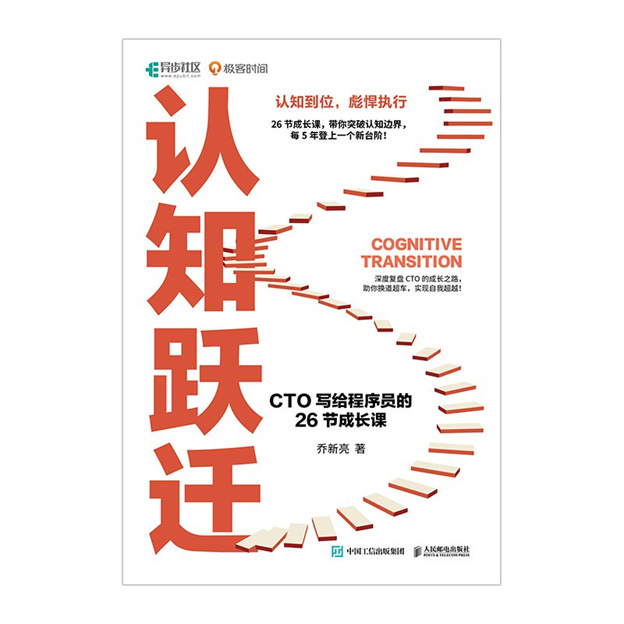
Cognitive Leap (《认知跃迁》) is a new Chinese self-growth book by tech leader Qiao Xinliang (乔新亮). Its goal is to guide readers through “cognitive leaps” – fundamental shifts in thinking – to achieve personal and career breakthroughs. The author draws on his 20+ years of IT leadership (he was CTO of Suning and other major firms), structuring the book into 26 concise lessons that span personal mindset, management skills, and technical expertise. This ambitious scope is driven by an understanding that in today’s information explosion era, simply accumulating facts is not enough – one must restructure how one thinks about problems and growth.
The writing is down-to-earth and motivating. Readers report feeling as if Qiao is a trusted mentor speaking from hard-won experience. Rather than vague platitudes (no “get rich quick in 3 steps” here), each lesson is grounded in real-world scenarios. The book is also physically well-produced – thick paper, full-color highlights, and “growth notes” at the end of each subchapter that summarize key points. In short, Cognitive Leap promises a user-friendly roadmap for anyone seeking to upgrade their mindset, especially amid today’s cognitive overload.
Key Ideas
The book’s structure is split into three main parts, reflecting Qiao’s “three dimensions” of growth:
Part I: Personal Cognition – Career, Choices, Growth. Six chapters (1–6) focus on the individual’s mindset and career planning. Topics include “Career Planning: a Tech Person’s 5-Year Leap” and “Money vs Growth: Beyond Salary”. Other chapters teach how to see problems at their root, make strategic life choices (city vs hometown), and even “The Art of Asking Questions” – a concrete skill for boosting work efficiency.
Part II: Management Skills – Organization, Team, Strategy. Ten chapters (7–16) cover the challenges of leadership. Qiao draws on his CTO experience to explain “Optimizing Team Structure”, “Boosting Collaboration Efficiency”, and “Balancing Strictness and Empathy” (the latter as a “yin-yang” management style). He also addresses higher-level thinking – “Global Thinking”, “Focus and Tradeoffs”, and “Risk Management”. These lessons teach how to lead teams and make strategic decisions in a fast-changing workplace.
Part III: Professional Growth – Architecture, Product, Design. Ten chapters (17–26) shift to domain expertise. Here the focus is on product and technical systems: “Architecture Decisions: Core Skills for Tech Leaders”, “Product Thinking: From Contracts to Human Insight”, and design topics like “High-Availability Design” and “Scalability: Looking Beyond Technology to the Business”. The final chapters cover monitoring, building robust systems, and “Migrating to the Cloud”, emphasizing that mastering technology is also a path to broader career advancement.
Throughout all sections, a few key ideas recur: introspection and reframing. Each lesson is prefaced by a personal anecdote or question that invites the reader to reflect, and it ends with a concise “growth note” (成长笔记) that distills the wisdom in simple language. Diagrams and bullet points are used to make complex concepts accessible. As one reviewer notes, the design (color printing and bold highlights) helps a busy reader “quickly spot the main point” when flipping through each chapter. In effect, the book is a cognitive workbench: it guides the reader through exercises of thinking (e.g. questioning, big-picture planning) as well as practical skills (e.g. team management, system design).
Effectiveness and Originality
Many readers praise Cognitive Leap for its practicality and sincerity. Unlike abstract self-help platitudes, it reads like a conversation with an experienced mentor. Reviewer “木子李” highlights Qiao’s honesty: the author shares concrete details (his own five-year plans, a salary-doubling story, or facing server outages) with no sugar-coating. This authenticity makes the lessons feel valuable – one reader calls the book “a precious treasure for tech people” because it comes from real struggle. In this way, the book stands out from many motivational books that tend to recycle vague slogans. Instead, it tackles tough topics head-on (for example, the anxiety of job-35 in tech) and shows how clear thinking can overcome them.
Another aspect of effectiveness is the completeness of its advice. The three-part structure ensures that readers not only rethink their mindsets but also get actionable tips on managing teams and designing systems. As a reviewer notes, Qiao’s chapters “directly hit real workplace scenarios” – from project management to communication skills – offering “concrete methodologies in soft skills like communication”. This practical bent makes the book useful even to readers outside of IT: it provides a full career roadmap from individual contributor to leader. The inclusion of step-by-step frameworks (for instance, the three-step question formula) gives readers tools they can apply immediately. Overall, its blend of cognitive science with career coaching is relatively original. While there are many books on habits or management, few in China (or elsewhere) package technical leadership lessons under the banner of “cognitive leap.”
That said, its heavy focus on a technical career does limit its audience somewhat. Non-technical readers might not find every chapter directly relevant. However, the underlying principles – planning ahead, focusing your attention, and reframing problems – are broadly useful. Psychology students may recognize parallels to concepts like growth mindset or metacognition. Still, some cognitive psychologists might wish for more discussion of empirical studies or psychological theories; the book stays anecdotal and motivational, not academic. In other words, its tone is one of personal experience and encouragement rather than rigorous theory. In practice this makes it engaging for a general reader but less of a textbook.
Compared to Other Works
In the landscape of self-growth and cognitive psychology, Cognitive Leap shares themes with several well-known works – yet it has its own flavor. For example, Daniel Kahneman’s Thinking, Fast and Slow teaches the reader to be aware of automatic (fast) vs deliberate (slow) thinking. Qiao’s book similarly urges readers to slow down at key moments (e.g. planning) rather than act on autopilot. However, whereas Kahneman focuses on experimental psychology, Cognitive Leap is much more of a career- and skill-oriented manual. It reminds one of Carol Dweck’s Mindset, in that both emphasize shifting one’s underlying beliefs (from fixed to growth). But again, Qiao applies these shifts in very concrete career contexts (e.g. “can I switch cities or roles?”) and tech-related challenges (e.g. scaling a system).
In the realm of practical business books, it has some kinship with Cal Newport’s Deep Work or Stephen Covey’s 7 Habits, in that it asks readers to be strategic about their time and focus on fundamentals. The “first principles” approach mentioned in Qiao’s chapters (inspired by thinkers like Elon Musk) echoes common advice in entrepreneurship literature. Yet Cognitive Leap is notable for combining that advice with technical know-how: it goes from “meta” thinking down to nitty-gritty like designing fault-tolerant architectures. One can say it sits at the intersection of personal development, leadership training, and technical education. In Chinese personal-growth circles it might be compared to books like 王达’s Cognitive Breakthrough (《认知破局》) or 古典’s Leap (《跃迁》), which also talk about upgrading one’s thinking. Indeed, one review of 认知破局 warned that in our information age we suffer a “cognitive overload” – we have access to more data than ever but our thinking efficiency is dropping. Cognitive Leap positions itself as part of the solution: a kind of “cognitive Ark” organizing knowledge into an actionable framework.
Overall, while there are overlaps, Cognitive Leap feels fresh in its singular focus on the tech-professional’s journey. It doesn’t just encourage better habits or attitudes; it maps out a progression from coder to CTO using cognitive science as its lens. This integration of tech career advice with mindset theory is relatively unique, making the book original in spirit.
Practical Takeaways
The book is packed with hands-on methods. Here are some of the most concrete takeaways that readers can apply:
Strategic Career Mapping. Plan long-term goals rather than react to day-to-day pressures. For instance, Chapter 1 urges readers to set a “5-year leap” career plan. Rather than focusing only on salary, ask “what skills and experience will I need to reach the next level?” and build a roadmap. This aligns with the idea of cognitive anchors – carving out space to identify what really matters.
The Art of Asking Questions. Chapter 5 introduces a simple but powerful formula: when raising an issue, always state (1) the context of the problem (what happened), (2) what you’ve already tried to fix it, and (3) exactly what help you need. One reader reports that mastering this “error+attempts+SOS signal” routine immediately led colleagues (even the CTO) to proactively offer support. In short: by structuring your questions clearly, you save everyone time and get better help.
Reflective Growth Notes. After each chapter, use the provided “growth note” as a model for self-reflection. Summarize what you’ve learned and how it applies to your situation. Writing or discussing these notes can solidify the lesson (“Why does this matter for me?”). The book itself uses color-highlighted keywords and diagrams to emphasize core ideas, so try creating your own notes or mindmaps for complex topics.
Yin-Yang Management Balance. In leadership chapters, Qiao stresses balancing two styles. Think of team management like eating hot pot – you need both the spicy KPI “broth” and the oil dip of personal rapport. Learn when to be strict and when to be supportive (Chapter 10). For example, establish clear metrics (KPI) and regularly show appreciation or build relationships. This dual approach helps maintain team trust while still pushing for results.
Product Thinking and Systems Design. The latter chapters teach you to adopt a broader mindset about your work. Instead of just building features, ask “what problem am I really solving for the user?” (Chapter 19). Similarly, when designing systems (Chapters 17–26), always consider real-world constraints and failure modes. For example, the book explains how to monitor a live system or plan for “what if” scenarios (Ch. 24–26). One key principle is to treat reliability like a contract: build in backups and alerts so that even when things break, you stay in control.
Meta-Cognition and “Cognitive Anchors.” Finally, the book implicitly encourages higher-order thinking habits. Carve out regular “meta-thinking” time as Musk’s first-principles approach suggests – for example, schedule weekly review sessions to step back from daily tasks and reassess your strategy. This could mean an hour of reading widely, or a weekend retreat to revise your career plan. Building such “anchors” prevents you from being swept away by every new trend or “Shiny Object.”
These takeaways come from the book’s own lessons and the experiences shared by early readers. They illustrate how Cognitive Leap is far more than theory; each chapter offers practical actions you can start using immediately.
Relevance in Today’s World
Why does a book like Cognitive Leap matter in 2025? As several analysts observe, we now live in an information-saturated age. Finding information is trivial, but using it effectively is hard. As one review notes, the 21st century has seen “unprecedented cognitive stress: easy access to knowledge contrasted with declining thinking efficiency”. In this context, merely accumulating facts or following routines leads to burnout or “analysis paralysis.” What’s needed is methodical thinking – a way to filter, organize, and apply knowledge.
Cognitive Leap directly addresses this challenge. Its 26 lessons act like a cognitive training program: they teach readers how to process information strategically. By focusing on mindset shifts (认知跃迁) rather than rote learning, the book helps break through the noise. For example, the emphasis on systematic reflection (via growth notes) and core principles (asking first-principles questions) equips readers to turn fragmented data into coherent plans. In effect, it functions as a “cognitive Ark” in the flood of information.
Furthermore, the book’s motivational style meets the modern appetite for accessible guidance. In an era where many people feel stuck (“inner involution” or 内卷), learning from someone who has already navigated those pressures is inspiring. Many readers report that the book gave them renewed confidence or concrete ideas to escape stagnation. In short, it is relevant today because it answers the question: How do we thrive intellectually and professionally when we’re drowning in data and expectations? By advocating deep work, continuous learning, and cognitive reframing – all hallmarks of success in a digital age – Cognitive Leap provides timely tools for the “next level” of personal growth.
Cognitive Leap is a highly practical and engaging guide to self-improvement, especially tailored for our information age. It combines personal reflection with career strategy in a way that feels both authentic and actionable. Readers can expect to learn not just motivational clichés, but real techniques: from planning a multi-year career path to handling a system outage with calm analysis. The author’s credibility (a seasoned CTO) and the book’s clear, colorful design make it easy to follow.
For general readers and personal-development enthusiasts, the biggest takeaway is the mindset: that growth often requires a leap in how we understand ourselves and our work. Psychology students will recognize familiar themes (like mindset shifts and metacognition) presented in a fresh, applied context. And in today’s fast-paced world, the book’s insistence on slowing down to think deeply is a valuable counterpoint to our usual overload.
In summary, Cognitive Leap is a motivating, reader-friendly toolkit for rising to the challenges of modern career and life. It may be framed as “CTO lessons for programmers,” but its core lessons – strategic thinking, continuous self-assessment, and purposeful action – are universal. As one enthusiastic reader puts it, finishing the book feels like gaining the “secret code” to growth. Anyone looking to cut through the noise and level up their thinking will find this book a worthwhile companion.