

Asylum Dream Shattered
What the Collapse in Approval Rates Reveals About Another America
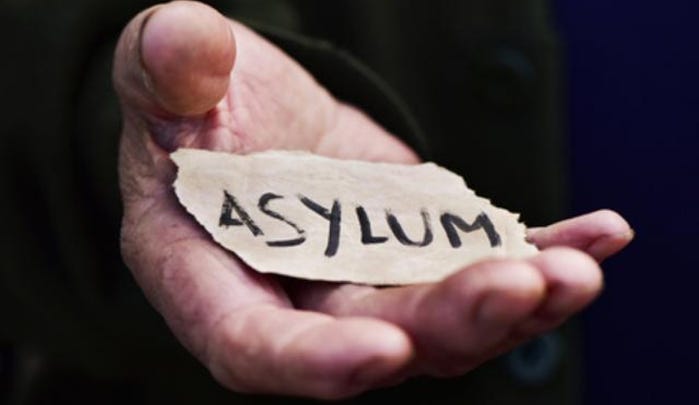
[The United States is stepping back from the role of “guardian of universal values,” and returning to an older self, one that puts national interest first.]
Li Zhide (李志德)
In the past two years, the tightening of political asylum in the United States has become more than a matter of a few stricter judges or a few harder cases. It feels more like a clear signal: America is rewriting itself, moving away from being a haven for the persecuted and back toward being a keeper of borders and national interest. Data from TRAC show that the asylum approval rate in U.S. immigration courts had fallen to 35.8 percent by October 2024, and then to 19.2 percent by August 2025, nearly cut in half. At the same time, after Donald Trump (特朗普) began his second term, the White House wrote “America First” directly into its foreign-policy and border-policy documents, making plain that everything must serve, first of all, the safety and interests of American citizens.
Many people read this as a sign that America has “turned right.” A more exact way to put it is this: America has not suddenly changed. It is returning to an older line in its own history. When national interest, domestic anxiety, and electoral pressure rise to the surface, it does not keep waving the banner of universal values. It closes the door first, raises the border higher, and puts “Americans first” at the front of the line. The sudden chill in the asylum system today is one more moment when that old logic has overrun the value-laden language of the Cold War era.
This has hit Chinese people especially hard. For years, many assumed that America would naturally show more patience, and more willingness to receive, those who came from authoritarian states. During the Cold War, the United States did in fact treat the reception of those fleeing communist countries as a showcase for the superiority of its system. But that logic is now failing fast. It is not because America has suddenly stopped criticizing China. It is because what America cares about now is no longer, “Can I change others through asylum?” but rather, “Is this system still worth the cost it asks me to bear?”
At the start of Trump’s second term, the White House issued one document after another—“America First Policy Directive,” “Protecting the American People Against Invasion,” “Securing Our Borders,” and the like. The language was blunt. American diplomacy, it said, must always put the United States and its citizens first. The federal government must put the safety, economic well-being, and interests of Americans first. Border policy, it said plainly, must work to “end asylum for those who cross illegally.” That is different from the old method, which wrapped itself in the language of values while tightening quietly in the background. Now the message is out in the open: nation first, morality second; border first, sympathy after.
So the fall in asylum approval rates today cannot be understood simply as a technical matter in the courts. There is, of course, a technical side to it. The materials are examined more closely. The questioning is sharper. Judges are less willing to leave room for vague narratives. Cases that once survived on templates, talking points, and delay tactics are finding it harder and harder to make it through. But those technical changes are only the surface. The deeper fact is that the American state is losing interest in keeping the asylum system alive as a kind of global moral theater. During the Cold War, that theater had strategic value. If a person looked enough like someone who had escaped from an enemy system, America could claim moral standing, win propaganda points, and gain geopolitical advantage all at once. Today, those returns are shrinking, while the institutional costs are rising.
That is the heart of the matter: America has not lost ideology altogether. What it is shedding is the outward, asylum-based form of ideological politics. At home, it remains intensely ideological. The culture wars, race politics, and identity struggles are even fiercer than before. What has weakened is America’s willingness to keep playing the role of the country that shoulders the burden of the persecuted of the world. What it now seems to want is to be a nation-state with a clear border, one that gives priority to the feelings of its own voters and keeps as much of its institutional resources as possible for its own people. This is not a new phenomenon. It is something deeply familiar in American history.
One of the earliest, and most searing, lessons in that history was the Chinese Exclusion Act (《排华法案》) of 1882. It was the first major federal immigration law in the United States to impose sweeping restrictions on a specific ethnic group and class of laborers. The logic behind it was not complicated. When economic pressure, racial hostility, and local politics piled on top of one another, Chinese laborers could swiftly change from “useful people” into “dangerous people.” America did not fail to see that Chinese workers had contributed to railroad construction and the development of the West. But once anxiety about order took hold, even a country that called itself free was ready to shut the door.
If the Chinese Exclusion Act showed that America could sacrifice openness for the sake of domestic order, then the case of the St. Louis (圣路易斯号) in 1939 showed that it could also sacrifice its most obvious humanitarian duty for the sake of domestic politics. On that ship were 937 refugees, nearly all of them Jews, who had fled Nazi Germany. Cuba refused them landing. The United States and Canada did not take them in. In the end, they were forced back to Europe, and 254 of them later died in the Holocaust. What makes that case so important is not only its tragedy. It is that it makes one fact painfully clear: America does not always open its doors to the persecuted. Even when it knows what they are fleeing, it may still place border order ahead of human need.
Of course, America has another side as well. Once the Cold War arrived, refugee policy was reshaped in openly ideological terms. The Refugee Relief Act (《难民救济法》) of 1953 created special visa arrangements for nearly 200,000 refugees and “escapees” from communist countries. More striking still, the law’s definition of a “refugee” carried the clear imprint of the Cold War map itself: whether or not you had fled from the communist world directly affected whether America would regard you as someone “worth admitting.” That was no longer humanitarianism in any ordinary sense. It was the folding of refugees into geopolitical competition.
The Cuban Adjustment Act (《古巴调整法》) of 1966 made this even plainer. After the Cuban Revolution, the United States offered especially favorable legal status to Cuban exiles opposed to Fidel Castro (卡斯特罗). To receive them could, of course, be described as an act of protection. But it also served Cold War politics. America wanted to show that to flee communism and enter the United States meant entering a better life and a more legitimate system. Refugees here were not just victims. They were also living proof in a political narrative.
The Refugee Act (《难民法》) of 1980 is often seen as the high point of America’s effort to turn itself into a modern humanitarian state. That is because it brought U.S. refugee policy into closer alignment with United Nations standards and set up a more stable framework for admission and resettlement. Yet even at that stage, America was not acting apart from national interest. The refugee crisis in Indochina after the Vietnam War, the pressure of America’s international image, and the moral competition of the later Cold War all helped push that law forward. In other words, even when the United States came closest to looking like a “nation of universal values,” national image, strategic need, and moral principle were always bound together.
Once this historical line is laid out, the present becomes easier to see, and it becomes clear that many people misread the past. America did once welcome those who had “escaped from the communist world.” But that was never an unconditional humanitarian instinct. It was a political choice shaped by the Cold War order. Once the Cold War ended, the symbolic gain from such a choice began to decline. Today America faces a different set of pressures: strain at the border, fiscal cost, anxiety over public safety, electoral mobilization, and a broad social frustration with an immigration system seen as out of control. Under those conditions, the asylum system no longer looks, as it once did, like a badge that adds to America’s moral standing. More and more, it is seen instead as a high-cost, low-trust entry point that can easily inflame voters.
That is exactly why America can, today, treat China as its principal strategic rival in official documents, while no longer wishing to receive large numbers of asylum applicants from China. Many people have long assumed that the more anti-China America becomes, the more warmly it will welcome Chinese dissidents and those who flee. But history has never been that simple. American toughness toward China does not mean America is willing to pay the price of Chinese lives and destinies. Competition with China may take the form of struggles over technology, trade, sea power, supply chains, and security. The asylum system, though, is governed by a different calculus. The former concerns the contest between states. The latter concerns whether America is still willing to bear the institutional cost. In Washington today, it plainly seems that the return on that cost is falling.
For many Chinese applicants, this has been an especially harsh blow. Over the past few decades, an entire set of expectations grew up around asylum claims: if the story sounded right, if the posture was convincing enough, if the narrative could be made to fit America’s familiar moral script, then America would always leave a door open. But the reason the door opened was never simply that the story moved people. It was also that the America of that moment was willing to let such a story stand. Now the political climate that made those stories possible is disappearing, and with it, asylum itself begins to cave in.
In the end, what has really shattered today is not some particular application technique. What has shattered is an older way many people understood America. Once, people imagined the United States as a country that spoke of values first and interests second. Now they are seeing more clearly that, more often than not, it speaks of interests first. Values may be invoked when convenient. When they are not, they can be set aside. This is not the end of the American ideal. It is the return of the American instinct as a state. America has passed through Wilsonianism (威尔逊主义), through Cold War human-rights diplomacy, and through the liberal internationalism of the post–Cold War era. But when domestic pressure grows intense enough, it returns, again and again, to an older sentence: America first.
Seen from that angle, the plunge in political asylum today looks more like a symbolic exit. The United States is stepping away from the role of guardian of “universal values” and taking its place once more as a gatekeeper nation-state. The flag is still there. The slogans are still spoken. But the order that now does the real work is different: border first, citizens first, cost first, mission after.
For many people, the change has come too fast, and so it feels especially cruel. Yet set against the long arc of American history, it is not strange at all. What is strange is not that America has changed today. What is strange is that so many people, for so long, called it “the Beautiful Country,” and imagined it too beautifully, without seeing that there was always another face beneath the one they preferred to admire.