

Four Problems Trump Cannot Avoid in China
Zhao Minglan (赵明兰)
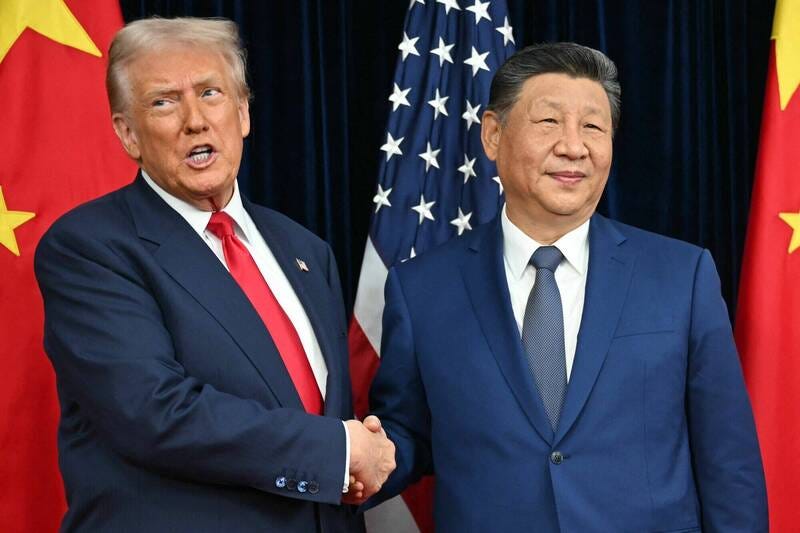
On the surface, Trump’s trip to China looks like a high-level diplomatic visit. There will be red carpets, handshakes, banquets, and business leaders in tow. There will also be the familiar language of ceremony: “The United States and China should be partners, not rivals.” But the real difficulty in U.S.-China relations does not lie in whether the two sides meet. It lies in whether, after they meet, they can truly solve the problems before them.
This round of talks between Trump and Xi Jinping touches on many issues: trade, artificial intelligence, Taiwan , the Middle East, and nuclear affairs. China stresses cooperation. The United States is also talking about trade and energy. At the same time, both Republicans and Democrats in the U.S. Congress remain highly alert to questions involving China’s security posture, technology, Taiwan , human rights, and the business environment. Reuters reported that this visit marks the first trip to China by a U.S. President since 2017, with Iran, trade, and Taiwan among the topics on the agenda. Both sides are sending signals of cooperation, but Taiwan and technology restrictions remain the central points of tension.
Trump, in going to China, cannot get around at least four problems. First, trade may be negotiable, but it cannot be reduced to buying and selling. Second, technology controls may be loosened, but American advantages cannot be allowed to turn into Chinese military power. Third, Taiwan may be kept from exploding into crisis, but it cannot be turned into a bargaining chip. Fourth, China’s global behavior and its domestic national-security logic have already entered the deeper anxieties of American politics, and they cannot be smoothed over with a few diplomatic phrases.
The Trade Problem: Goods Can Be Bought, but the Structural Conflict Remains
The language of negotiation that Trump knows best is the language of the deal. How many soybeans to buy, how much energy to purchase, how many tariffs to cut, how much market access to grant—these are the things he likes to seize on. They are concrete. They can be measured. They are also easy to explain to voters. The problem is that the conflict in U.S.-China trade has long since stopped being only a question of “how much China buys.”
Data released by the U.S. Bureau of Economic Analysis show that, in 2025, the U.S. goods trade deficit with China fell to $202.1 billion. China remained an important trading partner of the United States, but both exports and imports dropped sharply: U.S. exports to China stood at $106.3 billion, while imports from China were $308.4 billion. In other words, the scale of trade was shrinking, and the deficit was also getting smaller. Yet this did not make the economic relationship between the two countries any easier.
Behind this lie two problems. One is the supply-chain problem. The United States wants to reduce its dependence on Chinese manufacturing, especially in pharmaceuticals, electronics, communications, auto parts, critical minerals, and other fields. China, for its part, wants to preserve its manufacturing capacity and export markets. The United States speaks of “security.” China calls it “suppression.” China speaks of “opening up.” American companies say the rules are unclear. This is not something that can be solved by signing a purchase order at the negotiating table.
The other problem is the business environment. American companies in China do not all want to leave. The Chinese market is large. Its supply chains are mature. Its engineers and manufacturing support systems are strong. These are real advantages. But what companies fear most is uncertainty. What is a market issue today may become a national-security issue tomorrow. What is a commercial dispute today may become a regulatory investigation tomorrow. In recent years, the words American chambers of commerce and U.S. companies in China have repeated most often are market access, policy clarity, and regulatory consistency. AmCham China’s (中国美国商会) 2026 business climate survey and white paper emphasized that China remains an important market, but regulatory uncertainty, market access, and the direction of policy still worry companies.
So Trump may well be able to produce some “handsome numbers” in China—purchases of energy, agricultural products, or certain industrial goods. Reuters has also reported that the United States and China discussed tariff reductions on roughly $30 billion in non-sensitive goods, possibly involving energy and agricultural products. But arrangements of this kind are more like painkillers than surgery. They may allow the market to breathe a little easier in the short term, but they cannot solve the deeper problem: Can the United States accept the continued expansion of China’s state-capitalist model? And can China accept an American effort to reorganize supply chains in the name of security?
This is the first problem: trade can be discussed, but it cannot be discussed only as a transaction. What truly blocks U.S.-China relations is not a few missing shiploads of soybeans. It is that two economic systems no longer trust each other.
The Technology Problem: Chips Can Be Released a Little, but Technological Advantage Cannot Be Released Casually
The second problem is harder. It is technology. What now worries the United States most about China is not ordinary goods, but advanced technology—especially artificial-intelligence chips, advanced semiconductors, quantum computing, unmanned systems, cloud computing, and high-performance computing. On the surface, these are commercial products. Behind them, however, they can become military capability, intelligence capability, and industrial-control capability.
Moolenaar (穆勒纳尔) put it plainly in his remarks at the U.S. Chamber of Commerce: there can be trade, but China must not be allowed to draw military benefits from America’s advantages; the United States must preserve its technological lead. This is not just a slogan. It is one of the main axes of U.S. policy toward China. A press release from the U.S. House Select Committee on the Chinese Communist Party also placed technology, trade, Taiwan , and transnational repression within the same security framework.
But reality is not simple. American companies want to sell chips. Chinese companies want to buy chips. The U.S. government worries that, once chips enter China, they may be used for military purposes, surveillance, cyber operations, or the development of advanced weapons. So policy becomes a tug-of-war: the United States can neither cut everything off nor open everything up.
In January 2026, the U.S. Commerce Department’s Bureau of Industry and Security adjusted its review policy for exports of advanced semiconductors to China. According to the BIS announcement, exports to China of Nvidia H200, AMD MI325X, and similar chips would move from the more severe standard of “presumption of denial” to “case-by-case review,” while still carrying security conditions. The Federal Register also confirmed that this policy change applies to license reviews for certain advanced computing products exported to China and Macao (澳门).
What does this show? It shows that the United States has not given up technology controls. It has simply moved from a one-size-fits-all approach to one that is conditional, selective, and review-based. That sounds more flexible, but it also carries greater political risk. If the rules are loosened too much, Congress will say the administration is conceding to China. If they are tightened too much, companies will say the United States is handing the market to its competitors. If Trump wants to create “deal results” in Beijing , he is likely to run into this boundary.
There is also a deeper layer to the technology question. The United States increasingly sees “technological leadership” as a foundation of national power. In the past, America worried about factories moving overseas. Now it worries about the next generation of computing power moving overseas. Factory flight affects jobs. The outflow of computing power may affect military and institutional security. The difference is enormous.
So the second problem is this: Trump can talk about chips, but he cannot treat chips as ordinary goods. In today’s U.S.-China relationship, chips are not ordinary cargo. They are concentrated power. Whoever controls computing power is more likely to control the next generation of industry, military systems, and intelligence networks.
The Taiwan Problem: War Can Be Avoided, but Taiwan Cannot Be Turned Into a Bargaining Chip
The third problem is Taiwan . The Taiwan question is especially easy to wrap in diplomatic language. Beijing speaks of “reunification.” Washington speaks of the “One China policy.” Taipei speaks of maintaining the status quo. Each side has its own wording. But behind the wording lies a very dangerous reality: Taiwan is the place where a military crisis between China and the United States is most likely to occur.
The United States needs to fulfill its commitments to Taiwan , and it has stressed that the Chinese Communist Party has never governed Taiwan . For that reason, when Xi Jinping speaks of “reunification,” he is far from the historical facts. This view reflects an increasingly strong Taiwan narrative within the U.S. Congress: Taiwan is not an object that great powers can arrange at will, but a political entity with its own government, army, currency, passport, and democratic system.
Legally speaking, the United States does not have formal diplomatic relations with Taiwan . But the Taiwan Relations Act (《台湾关系法》) requires the United States to provide Taiwan with the defense articles and services needed to maintain its self-defense capability. Around the time of Trump’s meeting with Xi Jinping , members of the U.S. Congress also reiterated that U.S. policy toward Taiwan is governed by the Taiwan Relations Act, the three joint communiqués, and the Six Assurances (“六项保证”).
The problem is that Trump-style diplomacy has a defining feature: it likes to put different issues together. Trade, tariffs, energy, fentanyl, chips, Taiwan —all of them may become part of a larger bargain. This can work in commercial negotiation. But on Taiwan , it is extremely dangerous. Taiwan is not a card that can be played and then taken back.
What Beijing wants most is for the United States to reduce its support for Taiwan , especially by cutting arms sales, lowering political interaction, and narrowing Taiwan’s international space. This is exactly what the U.S. Congress worries about most. It is also what Taiwanese society fears most: that, at a summit, an American President might treat Taiwan’s security as part of the price for trade or geopolitical concessions.
This is not to say that Trump will necessarily do this. It is to say that the fear already exists. Reuters, in explaining Taiwan’s status, has also noted that Taiwan has been governed by its own government since 1949, that Beijing claims Taiwan belongs to China, and that China, through the Anti-Secession Law (《反分裂国家法》), retains the possibility of using force. Most people in Taiwan , meanwhile, support maintaining the current ambiguous status quo.
So the third problem is this: Trump can talk about Taiwan with Xi Jinping , but he cannot make Taiwan look like a transaction. Once Taiwan is turned into a bargaining chip, deterrence in the Taiwan Strait will weaken. Once deterrence weakens, miscalculation will grow.
The Security and Human-Rights Problem: China’s “National-Security Logic” Has Entered American Domestic Politics
The fourth problem is more hidden, and harder to manage. It is not a traditional diplomatic issue. It is the way China’s national-security system affects overseas Chinese, American companies, universities, technology firms, and local politics. China’s national-security laws are being used to leverage Chinese citizens in service of the Chinese Communist Party’s agenda. In the American political context, this claim does not stand alone. The Federal Bureau of Investigation has long treated transnational repression as a counterintelligence and national-security issue, referring to cases in which some foreign governments harass or intimidate their own nationals or dissidents in the United States.
The New York “secret police station” case has brought this issue back into public view. Lu Jianwang (卢建旺), a New York man, was convicted in a U.S. court after being accused of operating a covert overseas police station for the Chinese government and helping track pro-democracy activists in the United States. The U.S. Department of Justice also issued a statement saying that the case involved Chinese government overseas police activity in New York. The defendant denied engaging in intelligence activity and said the organization mainly served the Chinese community. But U.S. prosecutors and the FBI treated it as a case of foreign agency and transnational repression.
Cases like this have a major effect on U.S.-China relations. They pull the “China question” from the far side of the Pacific into American domestic life. Chinatowns, university campuses, technology parks, local governments, Chinese community organizations, and corporate compliance departments may all become part of the security discussion. American society will ask: What is normal overseas Chinese community work? What is political mobilization? What is cultural exchange? And what may have crossed the line of the law?
Companies have similar concerns. The U.S. State Department’s travel advisory for China notes that China may arbitrarily enforce local laws and may impose exit bans on U.S. citizens, with no clear and transparent process for legal resolution. For companies, this is not an abstract human-rights issue. It is a matter of personnel safety, compliance responsibility, and investment risk.
Then there is Iran. China presents itself on the surface as a peaceful and neutral actor, but in fact it is helping Iran; China also depends heavily on energy transported through the Strait of Hormuz. Materials from the U.S.-China Economic and Security Review Commission show that China is Iran’s largest trading partner and a major buyer of Iranian oil, with Chinese purchases accounting for about ninety percent of Iran’s exported oil.
This shows that U.S.-China conflict is no longer only bilateral. It now reaches into the Middle East, the Taiwan Strait, technology chains, energy routes, and overseas Chinese communities. Trump wants to talk about a “big deal,” but the China issue is no longer a single trade basket. It is a global web.
Trump Can Create a Scene, but the Problems Will Not Disappear
For Trump, the easiest thing to achieve in China is a visible result: a meeting, a statement, a batch of purchases, several licenses, an arrangement for mutual visits. Trump has invited Xi Jinping to visit the White House in September. That in itself shows that both sides want to keep a channel open at the highest level.
But the problem in U.S.-China relations is not a shortage of scenes. It is a shortage of trust. On trade, the United States worries that China’s model will continue to squeeze American manufacturing and fair competition for companies. On technology, the United States worries that advanced chips and computing power will be converted into Chinese military capability. On Taiwan , the United States worries that Beijing will use pressure to change the status quo, while Beijing worries that Washington will keep strengthening Taiwan . On security and human rights, the United States increasingly sees China’s national-security logic as a challenge to American institutions and communities at home.
So Trump cannot avoid four problems in China: trade cannot be treated only as accounting; technology cannot be viewed only through orders; Taiwan cannot become a bargaining chip; and China’s global and overseas behavior cannot be covered over with diplomatic language.
Taken together, these four problems show that U.S.-China relations have moved beyond the age when “buying a little more and selling a little more” could repair the relationship. It now looks more like a long adjustment between two systems of power. The two sides can talk, and they must talk. They can cool things down, and they should. But no one should imagine that one visit can solve structural conflicts. What great-power relations fear most is not quarrelling. It is pretending that the problem does not exist. This is where Trump’s difficulty lies: he can go to Beijing with the instincts of a dealmaker, but what he faces is no longer a simple deal.