From “Diner Kid” to “Chief Engineer of AI Infrastructure”
Reading The Thinking Machine: Jensen Huang, Nvidia and the World’s Most Coveted Microchip
Ren Jingjing (任晶晶)
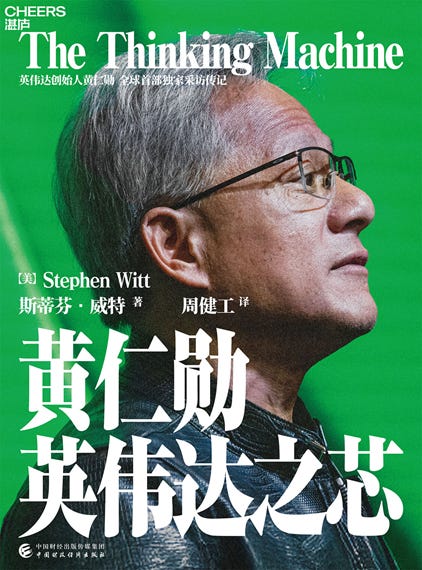
In the past two years, the name Jensen Huang (黄仁勋) has almost become a synonym for “artificial intelligence.” Nvidia’s (英伟达) stock price has multiplied several thousand times over a little more than two decades. In 2024, the company briefly reached the top of the global market-cap rankings and was described by many media outlets as “the most important company on the planet.” At such a moment, Stephen Witt’s (斯蒂芬·威特) The Thinking Machine: Jensen Huang, Nvidia and the World’s Most Coveted Microchip (《黄仁勋:英伟达之芯》) arrives and is hard not to see as the first major biography of the AI age.
The book is not long. The English edition runs to 272 pages. Its author, a journalist by training, continues the “story-driven” style he used in How Music Got Free. The publisher calls it “the story of how a small company designing graphics cards for video games ended up reshaping computer architecture and supplying supercomputer clusters worth hundreds of millions of dollars,” and also “the story of an entrepreneur who, under pressure from Wall Street, insisted on pursuing his own radical vision of computing” (Witt). This description sets the tone: the book is about a man, a company, and a technological revolution that is still unfolding.
What This Book Is Really About
Many Chinese readers come away with a similar impression: rather than a “personal biography” of Jensen Huang, the book reads more like a popular history of twenty-first-century AI and the GPU industry. Some even say that “a lot of the material can be found on Wikipedia, only told in a more engaging way.” This criticism is not unfair.
Witt writes in a classic American non-fiction style. The narrative follows a central figure, but the camera keeps pulling back to take in factory floors, stock exchanges, academic conferences, and garages. Large parts of the book are devoted to how graphics processors evolve from game cards into “general-purpose parallel computing engines,” and to how CUDA, once a niche project inside an engineering team, turns into the indispensable infrastructure for training today’s large models.
This approach has strengths and weaknesses. The strength is that readers do not just see a “legendary CEO,” but a complete technical and industrial chain: from game consoles and PCs to data centers and cloud services, and from there to applications such as ChatGPT. The causal links are much clearer than in most news reports. For people unfamiliar with the chip industry, the book offers a real entry point.
The weakness is the same thing. Because the author is so eager to explain how the “AI revolution” happened, he says relatively little about Huang’s private life, emotions, faith, or family. Some Chinese reviewers feel the book is “very much a reporter’s book, like a humanities student’s quick tour through a world of engineers,” and they point out that there is repetition and some “padding.” From the standpoint of a strict literary biography, these complaints are understandable.
But if the question shifts from “Is it detailed enough?” to “What does it manage to capture?”, the book’s real interest lies precisely in this blur between biography and industry history. It lets one person and one company ripple outward into a much larger technological wave, instead of turning them into an isolated “genius story.”
Anger and Resilience
In interviews, Witt has said that he conducted more than two hundred conversations around Jensen Huang, speaking with classmates, colleagues, and competitors. These interviews support the book’s most moving pages: how an immigrant teenager, after a string of setbacks, learns to turn anger into action.
The book revisits Huang’s experience of being bullied at a boarding school in the United States. When he first arrived, his English was poor. His skin color and accent made him stand out. At a Kentucky boarding school, he was often beaten up and mocked. Later, when he mentions those years, he tends to smile faintly and say he “doesn’t really remember the details anymore.” Witt reminds readers that this kind of “forgetting” is often only the surface layer that covers healed wounds.
Then there is the well-known car crash. At twenty-one, after a party, Huang drove drunk, taking a mountain road late at night. On black ice, his car lost control and plunged down a slope. He was pulled, blood-soaked, by rescuers from a twisted wreck. A Tencent Book Review (腾讯书评) piece titled “Jensen Huang’s Anger: Failure Must Be Made Public” notes that this incident was long ignored in other profiles; only Witt, after combing through old files and accident records, dug it out and pressed him on it.
School violence and a near-fatal crash are not “chicken-soup moments.” They are part of a person’s bedrock character. In the book, Witt keeps circling back to Huang’s “anger”: anger at injustice, anger at incompetence, anger at his own mistakes. One reviewer writes that Witt’s Huang is “an entrepreneur who is sometimes set alight by anger.” That fire later becomes a core part of Nvidia’s internal culture: failure in experiments is tolerated, but laziness and going through the motions are not.
Seen this way, the “thinking machine” in the title refers not only to GPUs, but also to this man, who is constantly “computing” in his own head. Violence and setbacks do not leave him stuck in self-pity. They push him to treat himself as a system that needs engineering work: fill in whatever ability is missing, and wherever he has stumbled before, train until he becomes strong.
Nvidia’s “Reverse Game”
Nvidia was founded in 1993, and the founding agreement was signed at a table in a Denny’s restaurant (Denny’s 连锁餐馆). At the time, the stars of the PC world were still Intel and Microsoft. Graphics chips were not considered a “high-end track.” Huang and his two engineer co-founders bet on what sounded like a marginal market: hardcore gamers who would pay for more realistic lighting and shadow effects.
The book shows that this choice was not romantic. It was a cool calculation. Intel had a firm grip on CPUs, leaving little room for new entrants. Graphics chips, by contrast, required strong parallel computation, high bandwidth, and low generality. That gave a newcomer a reason to stay away from the giants’ turf.
What truly changed Nvidia’s fate was CUDA. Around 2006, Huang made a big bet. He ordered the company to build a unified programming model on top of its existing GPU architecture, so that scientists and engineers could write parallel programs as if they were writing C, instead of writing separate drivers for every graphics card. At that time, Wall Street was more excited about mobile chips and consumer electronics. Inside Nvidia, many also feared that this “general-purpose parallel computing” might become an expensive toy.
Witt spends many pages on this gamble. Nvidia loses in the mobile-chip race. It rides dramatic booms and busts in cryptocurrency. Its autonomous-driving business faces repeated doubts. Each time, Huang does not pour energy into PR or storytelling. Instead, he pushes his teams to press the underlying architecture again and again and to ask the most basic questions: What, exactly, is this computation doing? Where, exactly, is the bottleneck? If all the CPU assumptions are thrown out, is there another route?
This is what people today call “first-principles thinking”: instead of asking “What is hot in the market?”, first ask “What is physically and logically possible?” The book never uses this fashionable phrase, but the key choices along Nvidia’s path all follow this logic. Problems are broken down to their base layer and rebuilt, instead of being solved by chasing the winds of fashion.
When the age of large models arrives almost overnight and data centers all rush to acquire massive parallel computing power, CUDA has already been running stably for more than a decade. Its ecosystem is mature; developers are used to it. Only then do people suddenly realize that the “graphics-card factory” had long ago turned itself into an “AI infrastructure provider.” On this point, a review in The Wall Street Journal (《华尔街日报》) gives a vivid title: “From Denny’s to Dominance.”
One Man’s First Principles
If Jensen Huang is seen only as “a lucky man who picked the right track,” the most interesting parts of the book will be missed. A review in 21st Century Business Herald (《21 世纪经济报道》) sums him up as someone who “keeps engineering himself.” Faced with changes in technology, markets, and organizations, his first reaction is not to “tell a new story,” but to rebuild his own mental models and toolbox.
In the book, this “engineering” has at least three layers.
The first is a first-principles breakdown of technology itself. In many settings, Huang stresses that the value of GPUs is not just “prettier images,” but enabling machines to perform large-scale parallel computation in a way closer to the human brain. Witt traces the evolution from video games and scientific computing to deep learning, so that readers can see how each architectural shift grows out of a new definition of the “compute bottleneck,” rather than a simple race to match a rival’s specifications.
The second is the engineering of organization. Many reports describe Huang as a “difficult boss,” with very high standards who will call out reasoning flaws in meetings and embarrass senior managers. In Witt’s telling, this severity does not come from ego. It stems from something like a compulsive need for “system completeness.” Any piece held together by bluffing will eventually blow up in real competition. So, the company culture prefers brutal internal argument to being lulled by slick PowerPoint decks.
The third is the public handling of failure. The Tencent review notes that when talking about AI-risk questions, Huang has sometimes lashed out at what he saw as sensationalist media questions. Yet when it comes to missteps inside the company, he insists that “failure must be made public” and cannot be smoothed over. This is classic engineer thinking. If errors stay only in the minds of those directly involved, they lurk in the system. Only when written down and reviewed can they be fixed.
Taken together, these three layers make the book feel like a living textbook of first principles. Compared with many management slogans, they are plainer and harsher. The book does not tell readers, “Believe in yourself and you will succeed.” It asks a harder question: are people willing to keep revising the deepest layers of their technology, their organizations, and their emotions?
How to Place Bets in Uncertain Times
For ordinary readers, the book’s value does not lie in “copying Jensen Huang’s life,” nor in applying Nvidia’s strategy wholesale. It lies in several very simple questions.
The first is a sense of time. Nvidia was founded in 1993. CUDA came out in 2006. The company only became the darling of the world after the large-model boom of 2022. There are nearly thirty years in between. In those thirty years, Nvidia went through the dot-com bubble, the financial crisis, and the rise and fall of cryptocurrency. Capital-market moods pushed the company up and down like a roller coaster. What Huang really insisted on was not an “ever-upward” stock chart, but an architecture for computing that he believed could support the next few decades. For people living in an era of short videos and instant rewards, this kind of “slow variable” commitment may be harder to learn than any inspirational slogan.
The second question is one of boundaries. Witt does not portray Huang as a hero who “sacrifices everything for his career.” Instead, he shows someone who is constantly negotiating among family, identity, and a sense of home: a Taiwanese immigrant and an American entrepreneur; a man who speaks English in Silicon Valley, and Mandarin and Taiwanese on stages in mainland China and Taipei. This cross-cultural position makes him naturally wary of single stories. It also inclines him to look for the generality of technology across different systems and markets, rather than fall into simple camp mentalities.
The third is about risk and fairness. Nvidia is not a controversy-free company. Its tight hold on AI compute has prompted worries that “technological power is becoming too concentrated in a few firms.” Witt does not dodge such debates, but he also avoids turning them into conspiracy tales. Instead, he tries to bring the questions back to institutions and markets: Who sets the rules? Who bears the risks? Who enjoys the gains? For readers concerned with tech ethics and social inequality, this part of the book is a reminder not to stare only at the halo around a “star CEO,” but to see the complicated structures behind it.
Biographical Writing in a Reporter’s Key
Judged as a “book,” The Thinking Machine: Jensen Huang, Nvidia and the World’s Most Coveted Microchip also has its flaws.
Many Chinese reviewers note that the author’s understanding of chips and AI sometimes seems “a bit shallow,” and that technical readers may not find it satisfying. When explaining the differences between GPUs and CPUs, for example, the book leans heavily on analogies and stories, rarely going into architectural details. This is clearly deliberate. The intended audience is the general public, not computer-science majors. Yet in an era already flooded with AI jargon, readers are not necessarily afraid of a little “hard stuff.” What they fear more is being talked down to.
Translation has also become an issue. In some reading notes, Chinese readers point out that the Chinese edition renders a number of technical terms awkwardly, even incorrectly, and sometimes uses different translations for the same concept on a single page. This is not the original author’s fault, but it directly affects how Chinese readers experience the book. For a non-fiction work that doubles as a “technology primer,” accurate translation is almost a second act of authorship.
Another point of debate is how the book handles Huang’s private life. Compared with classic biographies, there is very little about his inner monologues, marital life, or relationship with his children. The lens spends more time in meeting rooms, data centers, and stock charts. This respects privacy, but it also flattens the portrait. For readers used to the wild ups and downs of books like Steve Jobs or Elon Musk, this one can seem a bit “muted.”
Seen differently, however, this muted tone may be exactly what Witt wants. His real subject is how a system works, not how a hero shoulders everything alone. In a time when many “success-literature” books push personal charisma to the limit, such coolness can be a welcome corrective.
Reading the “Thinking Machine” as a Mirror
For contemporary readers, The Thinking Machine: Jensen Huang, Nvidia and the World’s Most Coveted Microchip offers more than a legend. It offers a mirror.
One side of the mirror faces technology. It reminds readers to look at basic architectures rather than only at the latest application boom. Who controls compute power? Who controls compilers and toolchains? Who controls ecosystems? These questions will shape how technological power is allocated in the coming decades.
Another side faces the individual. Huang’s path runs from the bullied “little guy” at boarding school to the teenager washing dishes at Denny’s, and from there to being hailed as “one of the most important CEOs of the AI age.” Along the way, there are not so many dramatic “benefactors.” There are mostly a series of sober choices: which major to pick, which company to join, when to leave, how to rebuild a team after failure. Whether readers can distill from this a set of “working rules” that fits their own situation matters far more than memorizing how many speeches he has given or how many quotes he has coined.
A third side faces social structure. Nvidia’s rise would not have been possible without decades of public research funding in the United States and a capital market willing to tolerate risk. Its present controversies also cannot be separated from global supply-chain imbalances and the anxiety that comes with technological monopolies. Witt offers no simple answers. He lays these forces on the same canvas and lets readers decide for themselves whether today’s highly concentrated AI infrastructure is a historical necessity or just a passing phase.
Living in the Shadow of “Huang’s Law”
People sometimes joke that after Moore’s law, human society may now be entering an era of “Huang’s law,” in which computing power grows at an astonishing pace and every industry that depends on it is rewriting its rules. In this atmosphere, the book’s meaning is not to hand over a “secret manual” for success. It is to help readers understand what kind of world they are entering.
If a simple label is needed, this book could be called “a biography that puts a legendary figure back into his systems” and “a casebook on how to make long-term bets in a complex system.” The prose is not flamboyant. The explanations of technology are not perfect. But the book centers on one crucial theme: in a time thick with uncertainty and bubbles, the only things that can be trusted are still the simplest first principles—seeing far enough, breaking problems down small enough, counting carefully enough—and then having the resilience to turn each failure into fuel for the next iteration.
For anyone living in today’s AI surge, this may be the most practical lesson of The Thinking Machine: Jensen Huang, Nvidia and the World’s Most Coveted Microchip: do not rush to become “the next Jensen Huang.” First learn to treat one’s own life, career, and judgment as a “thinking machine” that needs long-term tuning.