

How Did The Great Wall Go So Wrong?
Ren Jingjing (任晶晶)
From “Dream Team” to “Turkey”
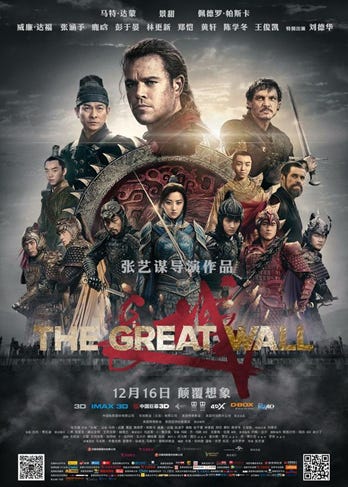
On paper, The Great Wall (《长城》) had everything it needed to become a legend. The director was Zhang Yimou (张艺谋), who had made Hero (《英雄》) and House of Flying Daggers (《十面埋伏》). The lead actor was Matt Damon (马特·戴蒙), an Oscar winner who moves easily between blockbusters and art films. The producers included Legendary Pictures (莱杰传奇) in Hollywood and, on the Chinese side, China Film Group (中影) and LeEco (乐视). The budget was about 150 million dollars, making it one of the biggest U.S.–China co-productions of its year.
We all know how that turned out: middling reviews, global box office that barely scraped its costs back, and plenty of outlets counting it as a loss. Even more awkward, a few years later Damon recalled on a podcast that he had felt something was off on set—“this is how disasters happen,” he said. “It just doesn’t cohere; as a movie it doesn’t work.” He even called The Great Wall a “turkey.”
In Zhang Yimou’s original plan, he wanted to make the Hollywood blockbuster in his head, so he went after Damon. Damon, for his part, signed on because of the combination “Zhang Yimou + Chinese historical setting,” hoping for something like a Chinese epic in the vein of Hero. To do the film, he really did give up the lead role in Manchester by the Sea (《海边的曼彻斯特》), staying on that project only as a producer. In the end, one man wanted to shoot “his own Hollywood movie,” the other hoped to shoot “someone else’s Chinese film.” What they made together was a strange hybrid neither of them fully owned. That, in the most literal sense, is what it means to be neither fish nor fowl (不伦不类).
To answer the question “How did The Great Wall blow it?”, you have to look at three layers. First, the film itself—does its structure, form, imagery, and theme hold up? Second, industrial logic—how did U.S.–China co-production and capital games push the movie in certain directions? Third, cultural perspective—how does it handle the business of “foreigners telling a Chinese story,” and how does it get stuck between a white hero and Chinese protagonists?
An Industrial Template Assembled into a Half-Finished Product
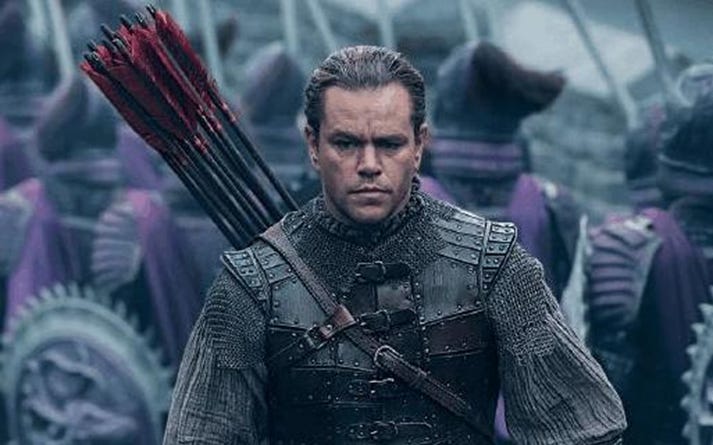
Start with the most basic level: story structure and narrative rhythm. The skeleton of The Great Wall is actually very standard. A Western mercenary, William (played by Matt Damon), comes in search of gunpowder and ends up trapped at the Great Wall. The enemy isn’t another army but monsters called taotie (饕餮). He begins as a cold drifter who lives only for himself, then is gradually moved by the discipline and sacrifice of the Wall’s defenders, and finally chooses to stay and fight alongside the Chinese army.
On paper, this is a classic Hollywood three-act structure. Act One: an outsider breaks into a sealed world and clashes with it. Act Two: after a series of battles and trials, he learns trust and cooperation. Act Three: in a final battle, he completes his transformation.
The trouble lies in the way it’s written and assembled. The screenplay is credited to Carlo Bernard (卡洛·伯纳德), Doug Miro (道格·米罗), and Tony Gilroy (托尼·吉尔罗), while the story is by Max Brooks (麦克斯·布鲁克斯), Edward Zwick (爱德华·兹威克), and Marshall Herskovitz (马歇尔·赫斯科维茨). Six people worked on the story at different stages, and then came notes from the producers and from the co-production side. It’s easy to see how it became a patchwork with everyone pulling in a different direction.
The result: the first part plays like a cross between traditional monster movie and kung-fu film—opening night battle, a parade of different corps, the rope-jumping women warriors, the gleaming formations. The middle adds a gunpowder heist, a conspiracy subplot, and black humor between William and his partner, played by Pedro Pascal (佩德罗·帕斯卡). The last act suddenly turns into a “defend the capital” sequence, with those color-coded armors traded in for urban chases and a glass-tower explosion.
Each section, taken on its own, moves along briskly enough. Put together, though, it’s hard for viewers to latch onto a real emotional through line. Are we supposed to be watching William’s growth “from selfish to self-sacrificing”? Are we watching how the Chinese army uses discipline and technology to fight the monsters? Or are we mainly here for the standard co-production slogans about “cultural trust” and “protecting humanity together”? Damon’s later summary hits the point: the movie doesn’t “stick” together; “as a movie, it doesn’t work.” Structurally, the biggest problem is that the film is never firm about whose point of view, whose desire, and whose change the story is really about.
Then there are the characters. William does have a basic arc—from mercenary to defender—but the turn happens quickly, often pushed through with a few lines of dialogue. Commander Lin Mae (林梅), the blue-armored heroine, looks like a key figure, with distinctive action choreography, yet her inner life barely opens up; she functions mainly as a mouthpiece for “discipline” and “duty.” Andy Lau’s (刘德华) strategist and Zhang Hanyu’s (张涵予) general are functional roles: they say a few wise lines and exit.
In Hollywood genre films, even in huge set pieces, the camera cuts back at key moments to show characters making choices—think Frodo and Aragorn in The Lord of the Rings (《指环王》) trilogy, or Furiosa and Max in Mad Max: Fury Road (《疯狂的麦克斯:狂暴之路》). The Great Wall throws enormous resources at its battle scenes, but rarely pauses to give the characters real moments of decision. So over the course of the film, there’s action, explosions, and sacrifice, yet almost no emotional beat that really sinks its teeth into the viewer’s heart.
Formally speaking, The Great Wall is a product polished on an industrial assembly line. But on the crucial question “who is telling this story, and whose story is it?”, it never makes up its mind.
Gorgeous Images, but Missing a Lock
Zhang Yimou has always been good at using color and choreography to build images. In Hero, the red, yellow, white, and green chapters mark out different narrative layers. In House of Flying Daggers, the bamboo grove, flying blades, and drum sequence are visual spectacles and also metaphors for the characters’ fates. The Great Wall continues this tendency and, at the same time, exposes a problem: when spectacle shifts from serving the story to serving the genre, the symbolic layer easily hollows out.
The film turns on several core images. The Great Wall itself. In reality, the Wall is a material symbol of the historical frontier between steppe and empire. In Zhang’s film, it becomes a line of defense against “beasts,” stripped of concrete historical and political content and turned into a pure military installation.
Then there are the color-coded formations. Different corps wear different colors of armor, which gives the images Zhang’s signature stage-like quality. But it’s hard for viewers to see actual people behind those colors. The women in blue armor, the red-armor archers, the black heavy infantry—by the end they mostly blur into parts of one big fireworks show.
And of course the taotie (饕餮) monsters. The writers borrow the name from Chinese mythology but design the creatures as a hive-mind swarm. In the background there’s a faint suggestion of “greed” and “imbalance,” yet the movie never articulates that symbolism clearly; it flashes by in a bit of exposition.
The result is a particular kind of awkwardness. Visually, the film is very “Zhang Yimou”: the colors, blocking, and formations all scream “blockbuster.” But on the level of imagery, it never really returns to China’s traditional political imagination of the Wall, the Mandate of Heaven, or the frontier. Nor does it build a new global metaphor—say, about power, capital, or technology turning monstrous.
You often see “almost a good metaphor” in the camera work. The monsters swarming one weak point in the Wall could stand for structural vulnerability. The emperor hiding inside the city while the army dies outside could stand for the separation of power and cost. Gunpowder is both a weapon and an object of trade, hinting at the flow of technology and violence between East and West.
But the film mostly stops at a first layer: “the monsters are scary,” “the army is brave,” “the outsider learns to sacrifice.” These images are locked inside the genre frames of “monster movie” and “action film.” They are never pushed upward into sharper, more demanding symbolism. Visually, the movie is lavish; symbolically, it hesitates.
A Wobbling Theme: Cooperation, Nationalism, or White Hero?
If you had to name an “official theme” for The Great Wall, the easiest answer would be “trust and cooperation.” A foreign mercenary comes for gunpowder out of selfish motives, fights in a few battles, begins to trust the Chinese soldiers, and finally chooses to defend the Wall alongside them, completing a personal redemption. This theme is not hard to accept, and it matches Damon’s early understanding. He has said that at first he thought the movie would be something like Lawrence of Arabia, Dances with Wolves, or Avatar—a story in which an outsider enters a closed system, is reshaped by it, and finds a new place amid conflict.
But on this theme, The Great Wall is pulled in several different directions at once.
One is the “national image film” that Chinese officials and capital clearly wanted. On screen, the Chinese army is disciplined, technologically advanced, and perfectly coordinated. The overall image is close to a period version of Wolf Warrior (《战狼》). The outsider ultimately admits that the “Chinese solution” is superior, which offers domestic audiences a familiar kind of narrative comfort.
Another is Hollywood’s need for a “marketable lead.” Global distribution, English dialogue, and early marketing all leaned heavily on Damon’s face. That all but guaranteed that he would have the most complete psychological arc and the biggest power of choice. The script is structured around that.
Then there is the public controversy around “white hero/white savior.” Before the movie opened, parts of the Asian American community in the U.S. asked whether this would be yet another story of a white man saving China. Zhang Yimou and the producers repeatedly explained that this was “an East–West co-production,” “a blockbuster deeply rooted in Chinese culture,” and that Damon’s character had been designed as a foreigner from the start. In other words, this wasn’t a case of “whitewashing” (白洗)—that is, taking a role that should have gone to an actor of color (Asian, Black, Latino, and so on) and giving it to a white actor, or rewriting a nonwhite character in the source material as white.
Strictly speaking, The Great Wall does not fit the classic definition of “taking a role meant for an actor of color and handing it to a white person.” But in terms of narrative focus, it never truly adopts the structure “the locals matter more than the outsider.” Chinese characters have the upper hand tactically, and they are placed on a higher moral plane, yet narratively and psychologically they are still supporting players. What they really move forward is William’s growth, not the unfolding of their own fates.
So three forces tug against one another. They want to show the Chinese army as a collective hero, but the market demands Damon be the lead. They want to tell a story of East–West cooperation, but dramatic structure naturally centers on “the one who changes the most.” They want to respond to “this is not a white savior story,” but truly making Chinese characters the leads would mean cutting back Damon’s screen time.
In the end, the producers chose a middle road. Damon’s character learns to acknowledge that the Chinese army is stronger and, on a personal level, to “learn from the East.” At the same time, he keeps his position as the narrative axis. In publicity, this path allows one version of the story for Chinese audiences and another for overseas audiences. Inside the film, though, it is hard to make it coherent. Viewers are left with a stubborn sense of awkwardness. The Chinese win the battle but not the narrative. The outsider completes his arc but always feels like a box-office guarantee wedged into place. The theme never truly commits. That is a key way the film “goes wrong.”
Industrial Tug-of-War: Director vs. Producers
In that later interview, Damon said something heavy. On set, he watched the Hollywood producers push Zhang Yimou to keep changing the story and sacrifice his original vision, and a thought crossed his mind: “This is how disasters happen.” That line opens up a deeper layer behind The Great Wall: the movie is not only a film, but also an experiment in “Chinese and American capital trying to understand each other.”
From an industrial point of view: for Legendary Pictures, The Great Wall was a test run in building a “global IP for the Chinese market.” For the Chinese investors, it was a ticket into the industrial system of global blockbusters, a chance to learn a full set of production and distribution routines. Both sides bet heavily, so both wanted control. Hollywood producers wanted the pacing, structure, and jokes to match global expectations for a commercial movie. Chinese investors and officials wanted Chinese images to be “positive, strong, and disciplined,” not too dark and not too complicated.
Caught between these demands, the director’s room to maneuver shrank. Zhang Yimou knows how to stage big scenes and handle sound and image, but this was his first English-language film. He had to work with international actors and juggle several production systems at once. Damon’s version is that as the producers kept “giving notes” and “tweaking the story,” the film gradually lost the clear sense of direction it had at the start and was reduced to a compromise solution that had been patched and repatched.
This is not unusual in co-productions. Everyone is afraid “the other side won’t get it,” so they keep adding safe options: more fighting, more expository dialogue, more explicit good and evil, more straightforward slogans. But movies are not meeting minutes. Too many compromises and too many patches usually don’t produce a film that “balances East and West.” They produce something both sides find unsatisfying.
The Great Wall is a textbook case. For many Chinese viewers, it doesn’t look like a real period film; it isn’t “refined” enough. For many overseas viewers, it is just another formulaic monster movie, with thin characters and plot.
To borrow Damon’s words, one of the minimum professional standards for an actor is: “You know you’re in a turkey, and you still have to grit your teeth and finish the last few months of work.” It sounds self-deprecating, but industrially it points to a simple reality:
When a project’s creative focus shifts from “the story” to “balancing multiple interests,” failure is often already written on the back of the budget sheet.
What “Neither Fish nor Fowl” Really Means
People have called The Great Wall “neither fish nor fowl” (不伦不类). Those four characters mean more than “neither properly Chinese nor properly Western.” They point to something deeper.
In terms of genre, the film wants to be a period epic and a sci-fi monster movie, and still squeeze in a bit of buddy movie energy between the two mercenaries. In cultural terms, it wants to be a “Chinese image film” and a “global entertainment film” at the same time. Industrially, it wants to learn from Hollywood and also prove that “China can play the Hollywood game too.” The three lines wrap around one another and, in the process, blunt each other.
If we look only at the film itself, we can sum up The Great Wall’s problems like this.
Its narrative through line is blurry: the protagonist’s motives keep wavering, and key emotional turns lack groundwork.
Its characters are shallow inside: the Chinese figures are heavily typified and rarely show sharp, individual desires and conflicts.
Its images and symbols stay on the surface: visually it has “Zhang Yimou style,” but it lacks deeper historical or political direction.
Its themes are pulled in many directions: cooperation, nationalism, and the white-hero debate all show up, but none is really thought through.
Add the industrial layer and you can say one more thing: this is a movie onto which its era projected “too many expectations.”
It was supposed to prove several things at once: that Chinese capital could handle global blockbusters; that co-productions could find new ways of telling stories; that Chinese stories could keep their own center of gravity inside a Hollywood system.
Those are big questions. The answer The Great Wall offers is a fragmented sample. Capital can pile up grand spectacles, but it cannot pile up a good story. Co-productions can assemble cultural elements, but they don’t necessarily tell cross-cultural emotion well. Hiring a foreign star for a Chinese period film does not automatically produce “exchange”; more often it reflects a market’s anxiety.
Lessons from The Great Wall for U.S.–China Co-Productions
The Great Wall is not worthless. It offers a very concrete negative example.
For Chinese cinema, it at least clarifies a few points. Learning Hollywood’s industrial methods is not the same as copying its templates. The real issue is not whether you use a three-act structure or a monster-movie form, but whether you have your own narrative core and your own sense of character destiny.
“Tell China’s stories well” cannot rely only on spectacle and positive images. Viewers care far more about whether the characters feel alive and whether the conflicts feel real than about how bright the armor is or how neatly the flags line up.
Casting international stars does not automatically bring international recognition. If the story never rises above surface-level cultural display, no matter how famous the actor is, they’re still just a face on the poster.
For U.S.–China co-productions, The Great Wall also sounds a warning. If both sides simply lay out what they want and “add it all together,” what you usually get is a dish nobody recognizes. Real collaboration doesn’t mean everyone taking a step back; it starts with deciding who is telling the story and whose experience is at the center, and only then talking about everything else.
In this sense, the answer to “how The Great Wall went wrong” is actually simple. In money and technology, the film stood at the front edge of its era’s U.S.–China cooperation. In story and point of view, it was afraid to offend anyone and afraid to fully trust anyone, so it never managed a single steady step.
The actual Great Wall was built to keep enemies out. The movie The Great Wall ended up trapped by a series of invisible walls instead: the wall of industry, the wall of the market, the wall of ideology. Each wall is higher than the last.
The failure here does not belong only to Zhang Yimou, Matt Damon, and a few producers. It is also a snapshot of a period when U.S.–China film collaboration tried to “bulk up overnight” through big-budget spectacle. That, more than the hordes of CGI monsters on screen, may be what’s worth remembering.
This review could use editing and a rework along with the film. It reads like it was written in the Department of Redundancy Department. You can do better.