

How Does a Country Fall into the Hands of a Tyrant
— On Reading Stephen Greenblatt’s Tyrant (《暴君》)
Ma Siwei (马四维)

In the twenty-first century, the word “tyrant” sounds like a term from an ancient-history textbook, yet it surfaces almost daily in the news and on social media. Electoral systems have not disappeared, information circulates more freely than ever, and still the stories of strongman rule, populist leaders, and a personalized state keep playing out around the globe.
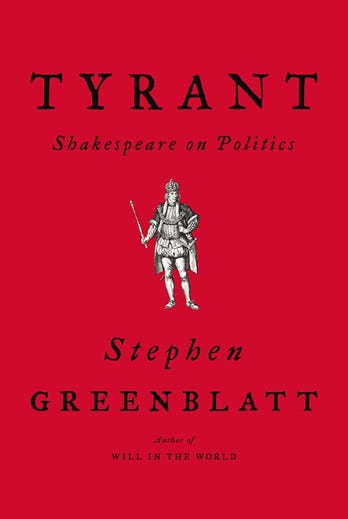
In 2018, Harvard scholar Stephen Greenblatt (斯蒂芬·格林布拉特) published Tyrant: Shakespeare on Politics (《暴君:莎士比亚论政治》), turning back to Shakespeare four hundred years ago and asking a blunt question: How does a whole country fall into the hands of a tyrant? This is not a general guide to Shakespeare studies, but a slim volume that uses Shakespeare to decode the logic of political power. In the West, it has been read as an oblique commentary on the age of Donald Trump. In the Chinese context, it also offers an intriguing mirror for thinking about imperial tradition, contemporary politics, and economic anxiety.
From Richard III to King Lear: The Pathology of Power
Tyrant selects a series of Shakespearean “problem figures,” from Henry VI and Richard III to Macbeth, King Lear, Coriolanus, and Julius Caesar. What Greenblatt tracks is not any single monarchical system, but the recurring interplay between tyrannical personalities and mass politics.
The book’s main lines of argument can be summed up in three points. First, tyrants are not monsters dropped out of the sky; they grow in the cracks of a society. In the chaos of Henry VI, Richard III moves like a predator crawling out of ruins: institutions collapse, the succession to the throne is contested, and noble factions are locked in struggle, opening space for a usurper. Through details on stage, Greenblatt shows that the rise of a tyrant usually rides on institutional failure, elite fragmentation, and popular resentment, not on private conspiracy alone.
Second, tyrants share a highly similar psychological structure. Greenblatt repeatedly stresses that Shakespeare’s tyrants display “infantile psychology and unquenchable narcissistic appetites.” Richard, Macbeth, and Lear find themselves in different circumstances, yet all are marked by intense feelings of persecution, treat the state as an extension of their own selves, and show a complete lack of empathy. Tyrants do not truly enjoy power. They are extraordinarily shrewd and alert while seizing it, but once on the throne, their lack of governing capacity and emotional control quickly drags the country toward disaster.
Third, tyrants never act alone; there is always a ring of hangers-on and accomplices. Greenblatt pays particular attention to these “enablers” and “followers”: sycophants at court, pragmatists among ministers, weather-vane generals, and willing propagandists. In Macbeth, they include Lady Macbeth and a host of retainers; in Julius Caesar, they are the nobles who sense danger but cannot articulate a workable response. The book stresses again and again that what allows tyrants to take power is the fact that large numbers of people choose to “pretend they don’t know,” and trade their own small calculations for short-term safety.
On the basis of such textual analysis, Greenblatt distills Shakespeare’s “political science” as follows: the tyrant is the product of warped popular sentiment, institutional breakdown, and pathological personality all working together. The tyrant’s fall, in turn, usually combines self-destruction with a heavy price paid by the state.
From Imperial Memories to Populist Impulses
Tyrant is about English kings, Roman senators, and Scottish nobles; it seems distant from China. But its account of how power concentrates, how societies acquiesce, and how ordinary people are whipped up in resentment echoes Chinese history and current reality in many ways.
The book nudges readers to rethink the long-standing “tyrant question” in China’s imperial tradition. In traditional Chinese historiography, the tales of King Zhou of Shang, the First Emperor of Qin, or Emperor Yang of Sui are often flattened into a moral narrative: the muddle-headed ruler loses virtue, Heaven withdraws its mandate. Tyrant, by contrast, emphasizes structural factors: elite power struggles, lack of institutional checks and balances, the politicization of the military, and accumulated popular anger. When these factors overlap, even a ruler once seen as “capable” can slide into tyranny. If one uses this lens on the Qin system, on one-man leadership, or on various cults of personality, old problems in China’s political culture no longer look like they simply disappeared with dynastic change.
The book also helps illuminate the dangerous linkage between “popular will” and strongman rule in modern societies. Greenblatt notes in the book and in interviews that Shakespeare was not only interested in tyrants themselves, but in how “the whole country” hands over power. In Julius Caesar, Roman citizens swing rapidly between positions under different orators. In King Lear, children who gain power move smoothly to strip the old king of his dignity. These stories can be lined up against any contemporary country undergoing rapid social transformation and widening inequality—including post–reform China. When the economy is booming, society shows a higher tolerance for centralized power. When growth slows, distribution becomes more unfair, and social mobility weakens, if there are no institutional channels for expressing discontent, populism and strongman worship naturally find a market.
The book issues an implicit warning against the logic of “development above all.” On stage, Shakespeare’s tyrants usually see themselves as “saviors of the nation.” They centralize power in the name of efficiency, order, and security, and treat all checks and balances as dead weight. This logic has appeared again and again in modern Chinese history: from the debate over “national salvation over enlightenment” to experiments that sacrificed individual rights in the name of industrialization. Through the plays, Greenblatt reminds readers that the efficiency of tyrants is often short-lived; the real cost is long-term damage to institutions and moral life. This is true in any country.
From “Political Philosophy” to “Cultural Poetics”
Compared with conventional political or intellectual history, Tyrant is distinctive in that it does not begin with archival material or institutional change, but draws political logic out of dramatic texts. This continues the “new historicism” that Greenblatt (格林布拉特) himself has championed: literary works are treated as nodes where power, social imagination, and historical context intersect, rather than as pure works of art.
Traditional studies of tyrants in history usually start from legal systems, fiscal structures, or military power. Discussions of the ancient Greek tyrannos (僭主), for example, analyze the structure of the polis and the tensions between aristocrats and commoners. Research on the Qin system in China emphasizes the commandery-county structure, the military merit nobility system, and agricultural taxation. Tyrant instead reads like a study in “the psychology of power” and “political rhetoric.” Its focus is on speeches, the stage, public emotion, and the ruler’s inner world. Every line, gesture, and silence from a tyrant onstage is taken as a political signal to the audience.
This approach differs from Hannah Arendt’s (汉娜·阿伦特) analysis in The Origins of Totalitarianism (《极权主义的起源》), which starts from intellectual history and social structure, and it extends a Western tradition of thinking about the “tyrannical personality,” from Plato to the seventeenth-century pamphlet Killing No Murder (《杀戮非谋杀》). Greenblatt brings this line of thought back into Shakespeare, layering literary criticism over contemporary political concern.
For Chinese readers, this method offers a “soft history” supplement: beyond the chronicles of emperors and officials, one can look at plays, novels, and online narratives to see how ordinary people imagine power. That perspective enters into dialogue with the elite-centered “Zizhi Tongjian–style” (《资治通鉴》) historiography. The latter emphasizes institutions; the former emphasizes emotion. Both ask the same question: how a community makes collective choices in times of crisis.
A Homegrown Chinese Reflection from Multiple Perspectives
Although Tyrant itself does not address China, the perspectives it offers lend themselves to a fresh look at the question “What is China?” Here, “what is China” refers not only to territory or ethnicity; it also involves how the state is imagined and how power is legitimized.
To begin with, stories about tyrants expose the dangers of turning the state into a single person. Chinese political language has long spoken of “family and state as one” and “the ruler as father,” encouraging people to see the state as the extension of a powerful personality, and to hand over their freedom and rights to a “wise sovereign” or “great man.” Shakespeare’s Lear and Macbeth show in vivid form what happens when “the state equals one person’s emotions”: the collective pays the bill for a leader’s mood swings. Read alongside Chinese history and contemporary politics, it is easy to see that this kind of personalization has by no means faded away.
Then there are the crowds. Shakespeare’s depictions of the masses unsettle China’s familiar “people narrative.” In traditional Chinese storytelling, “the people” are often an abstract whole, passively accepting the leadership of rulers or revolutionaries. Tyrant presents very concrete crowds: audiences in the theater, bystanders in the street, citizens in the Roman forum swayed by speeches. They are victims, but they are also active agents in a tyrant’s rise. This can remind Chinese readers that, even at home, “the people” can be manipulated and misled, and can end up participating in violence. They are not automatically a morally infallible subject.
The book’s focus on “elite complicity” likewise sheds light on the wavering of Chinese intellectuals and bureaucrats in modern times. From factional struggles within the Donglin movement in the late Ming to the “taking sides” of cultural elites in various political campaigns of the twentieth century, one can see their counterparts in Shakespeare’s nobles, generals, and counselors. Greenblatt emphasizes that these people often think they are “using evil to check evil” or “acting for the greater good,” yet in practice they chip away, bit by bit, at society’s defenses against tyranny.
Taken together, these parallels show that although Tyrant is written by an American scholar, it offers a valuable external frame of reference for China’s own history and reality. It reminds readers that when discussing “what is China,” it is not enough to rest on cultural pride or civilizational superiority. One must also confront the dark side of power structures and collective psychology.
Staying Alert to Tyrants in the Real World
After its publication in the West, Tyrant drew a great deal of praise, as well as criticism. Admirers focused on two strengths: the lively prose, which turns scholarly observation into accessible political essay, and the boldness of linking Shakespeare with contemporary politics, which made the book feel particularly timely in the Trump era. Some scholars, however, have argued that in “updating” Shakespeare, Greenblatt at times moves too directly, reducing complex historical experiences to thinly veiled commentary on current political figures. The Los Angeles Review of Books (《洛杉矶书评》), for instance, noted that Tyrant, in its analysis of today’s crises, sometimes attributes too much to personality and rhetoric, and too little to institutions and economic structures.
From the vantage point of Chinese readers, several questions invite further discussion. The first is how to connect an analysis of “the tyrant’s personality” with institutional and economic studies. On stage, Shakespeare’s tyrants often drive the plot through personal breakdown. In modern states, tyrannical rule is closely entangled with party-state structures, control of the military, media monopolies, and flows of global capital. Tyrant highlights psychology and rhetoric, but touches less on this layer. If read together with the political economy of Mancur Olson (曼瑟尔·奥尔森), Douglass North (道格拉斯·诺思), and others, the material foundations of strongman rule might come into clearer view.
The second is how to bring in non-Western experience and enrich the “gallery of tyrants.” In the book, Greenblatt mainly discusses English kings and Roman politics, and does not delve into tyrannical episodes in the Ottoman Empire, under the Russian tsars, or in the Chinese imperial tradition. This reflects the limits of his chosen material, not a flaw. Yet in a Chinese-language context, if one were to place the First Emperor of Qin, Wang Mang, Empress Wu Zetian, late Qing warlords, and twentieth-century dictators alongside Shakespeare’s figures, structural similarities and differences would become more visible.
Greenblatt writes about contemporary politics in Shakespeare’s language, with both scholarly skill and public concern. Tyrant does not offer simple judgments about which system is “good” or “bad.” Instead, it sketches a trajectory of power: how authority accumulates in the cracks of society, how it legitimizes itself with the help of the masses, and how, in narcissism and incompetence, it eventually collapses.
For understanding China, the book holds two kinds of significance. One is as a “mirror”: it allows readers to see familiar shadows in Shakespeare’s world—memories of empire, cults of strongmen, wavering elites within the system, and a public swinging between the expectation of a “savior” and the disappointment that follows. Such mirroring does not supply easy answers, but it does puncture the optimism that “history only moves forward and civilization inevitably progresses.” Tyranny is not just a leftover of the premodern age; it is a figure that modern societies can summon again and again in times of crisis.
The other is a “method”: Tyrant points to a way of understanding politics—starting from literature and theater, working through language, emotion, and scene, and using stories to probe the logic of the state and of power. For readers who care about “what is China,” this approach may be more convincing than abstract grand theory.
In Shakespeare’s plays, tyrants usually die in ruin: the country shattered, families torn apart. Audiences find a kind of “aesthetic justice” in such endings. Greenblatt’s book reminds its readers that in the real world, tyrants do not always pay the price so quickly, and the masses do not always awaken at the last moment. For any society, what matters more is learning to recognize, in the details of everyday life, those “infantile psychologies,” those “unquenchable narcissistic appetites,” and the “self-deceiving accomplices” who enable them—and to maintain a basic alertness to tyranny.
In this sense, Tyrant is not only a reader’s guide to Shakespeare; it is also a user’s manual for power in the modern age, addressed to all countries, including China. What it most insists that Chinese readers remember is this: in the stories of power, no nation is naturally immune. True security does not come from the moral fastidiousness and pride of saying “we are not like him,” but from a deep reckoning with how a country can end up in the hands of a tyrant, and from the courage to say no and stand up against him.