

Reflections on Minneapolis
— A Critical Thinking of “Operation Metro Surge”
Ma Siwei (马四维)
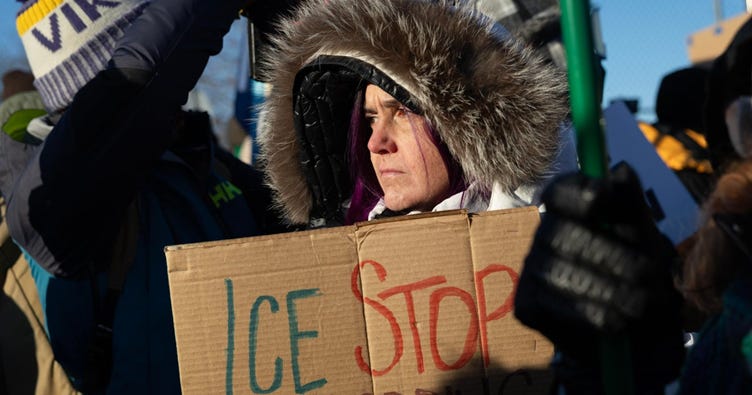
The “Operation Metro Surge” campaign in Minnesota has long ceased to be just an “immigration enforcement” operation. Beginning in December 2025, thousands of federal immigration and border enforcement officers poured into the Minneapolis–Saint Paul metropolitan area. The campaign was billed as “the largest immigration enforcement operation in U.S. history.” By the end of January 2026, roughly two thousand ICE (Immigration and Customs Enforcement) officers and one thousand Border Patrol agents had been deployed to Minnesota. In Minneapolis alone, around three thousand people were arrested, but only about five percent had prior violent felony records. During this period, two U.S. citizens—Renée Macklin Good (蕾妮·麦克林·古德) and Alex Pretti (亚历克斯·普雷蒂)—were shot and killed on the street by federal agents, and one detainee held by ICE died in custody.
Minnesota Attorney General Keith Ellison (基思·埃里森) described the operation as “a federal invasion of the Twin Cities and of Minnesota,” arguing that the deployment amounted to “an unlawful takeover of local public safety authority in the name of immigration enforcement.” Democratic Governor Tim Walz (蒂姆·沃尔兹) publicly called on the federal government “to stop this retaliatory operation.” Even a Republican candidate for governor, Chris Madel (克里斯·梅德尔), withdrew from the race because he could not accept his state being turned into a federal “test site for punishment.” At the same time, on January 31, a federal judge rejected an emergency request from the state and the two cities to halt the operation, ruling that the plaintiffs had failed to meet an “extraordinarily high bar.” In procedural terms, that decision opened the gate for the federal campaign to continue. So “Operation Metro Surge” has moved forward under the banner of “lawful enforcement,” even as it draws condemnation from local governments, civic groups, and the national media. It is precisely this tension that this essay seeks to examine.
Politics Replacing the Rule of Law: How “Federal Supremacy” Crushes Local Constitutional Order
On paper, “Operation Metro Surge” is defined as an enforcement campaign targeting “undocumented immigrants with serious criminal records.” It is presented as part of Donald Trump’s (川普) second-term plan for “mass deportations.” Trump himself has repeatedly promised to carry out “the largest domestic deportation operation in American history,” and has openly cited President Eisenhower’s “Operation Wetback” as his model.
But in practice, what is taking place in Minnesota goes far beyond traditional “border enforcement.” Minneapolis lies roughly three hundred kilometers from the Canadian border. It is well outside the usual one-hundred-mile radius in which border enforcement is most active, yet it has become the “showcase battlefield” for a massive deployment by the Department of Homeland Security (国土安全部). Thousands of federal agents have set up roadblocks, stopped pedestrians, and carried out unannounced home visits, to the point that many residents believed “martial law” had begun. Among those arrested are a significant number of documented immigrants, long-term residents, and even U.S. citizens. Many of the cases have nothing to do with violent crime, but instead involve traffic violations, visa overstays, or old errors in Social Security records.
The United States is a country where separation of powers coexists with a three-tier federal structure. Alexis de Tocqueville (托克维尔), in Democracy in America (《论美国的民主》), repeatedly stressed that local self-government is the true foundation of American democracy. He observed that American politics does not begin in Washington, but in the town meetings, county governments, and state legislatures of New England. What citizens first learn is not how to cast a ballot in a presidential election, but how to make decisions about budgets, roads, and schools in their own towns—matters that look trivial but shape public life. The three-layer structure of federal, state, and municipal (or county) government was built around this logic of self-government. The federal government takes charge of foreign affairs, national defense, and interstate matters. The states hold broad legislative and police powers. Cities and counties directly manage everyday concerns: schools, police, public health, land use, and taxation. Tocqueville believed that this bottom-up, layered system of self-rule let Americans practice their citizenship in daily life, learn how to take responsibility for common affairs, and at the same time structurally check the concentration of power. In other words, American constitutionalism is not sustained only by a single federal constitution. It is supported by countless local communities whose practices of self-government hold the whole structure up. Once federal power can easily leap over states and cities and deploy coercive operations directly inside communities, the original three-layer system is hollowed out. Th恶fandation
Ma Siwei (马四维)
The “Operation Metro Surge” campaign in Minnesota has long ceased to be just an “immigration enforcement” operation. Beginning in December 2025, thousands of federal immigration and border enforcement officers poured into the Minneapolis–Saint Paul metropolitan area. The campaign was billed as “the largest immigration enforcement operation in U.S. history.” By the end of January 2026, roughly two thousand ICE (Immigration and Customs Enforcement) officers and one thousand Border Patrol agents had been deployed to Minnesota. In Minneapolis alone, around three thousand people were arrested, but only about five percent had prior violent felony records. During this period, two U.S. citizens—Renée Macklin Good (蕾妮·麦克林·古德) and Alex Pretti (亚历克斯·普雷蒂)—were shot and killed on the street by federal agents, and one detainee held by ICE died in custody.
Minnesota Attorney General Keith Ellison (基思·埃里森) described the operation as “a federal invasion of the Twin Cities and of Minnesota,” arguing that the deployment amounted to “an unlawful takeover of local public safety authority in the name of immigration enforcement.” Democratic Governor Tim Walz (蒂姆·沃尔兹) publicly called on the federal government “to stop this retaliatory operation.” Even a Republican candidate for governor, Chris Madel (克里斯·梅德尔), withdrew from the race because he could not accept his state being turned into a federal “test site for punishment.” At the same time, on January 31, a federal judge rejected an emergency request from the state and the two cities to halt the operation, ruling that the plaintiffs had failed to meet an “extraordinarily high bar.” In procedural terms, that decision opened the gate for the federal campaign to continue. So “Operation Metro Surge” has moved forward under the banner of “lawful enforcement,” even as it draws condemnation from local governments, civic groups, and the national media. It is precisely this tension that this essay seeks to examine.
Politics Replacing the Rule of Law: How “Federal Supremacy” Crushes Local Constitutional Order
On paper, “Operation Metro Surge” is defined as an enforcement campaign targeting “undocumented immigrants with serious criminal records.” It is presented as part of Donald Trump’s (川普) second-term plan for “mass deportations.” Trump himself has repeatedly promised to carry out “the largest domestic deportation operation in American history,” and has openly cited President Eisenhower’s “Operation Wetback” as his model.
But in practice, what is taking place in Minnesota goes far beyond traditional “border enforcement.” Minneapolis lies roughly three hundred kilometers from the Canadian border. It is well outside the usual one-hundred-mile radius in which border enforcement is most active, yet it has become the “showcase battlefield” for a massive deployment by the Department of Homeland Security (国土安全部). Thousands of federal agents have set up roadblocks, stopped pedestrians, and carried out unannounced home visits, to the point that many residents believed “martial law” had begun. Among those arrested are a significant number of documented immigrants, long-term residents, and even U.S. citizens. Many of the cases have nothing to do with violent crime, but instead involve traffic violations, visa overstays, or old errors in Social Security records.
The United States is a country where separation of powers coexists with a three-tier federal structure. Alexis de Tocqueville (托克维尔), in Democracy in America (《论美国的民主》), repeatedly stressed that local self-government is the true foundation of American democracy. He observed that American politics does not begin in Washington, but in the town meetings, county governments, and state legislatures of New England. What citizens first learn is not how to cast a ballot in a presidential election, but how to make decisions about budgets, roads, and schools in their own towns—matters that look trivial but shape public life. The three-layer structure of federal, state, and municipal (or county) government was built around this logic of self-government. The federal government takes charge of foreign affairs, national defense, and interstate matters. The states hold broad legislative and police powers. Cities and counties directly manage everyday concerns: schools, police, public health, land use, and taxation. Tocqueville believed that this bottom-up, layered system of self-rule let Americans practice their citizenship in daily life, learn how to take responsibility for common affairs, and at the same time structurally check the concentration of power. In other words, American constitutionalism is not sustained only by a single federal constitution. It is supported by countless local communities whose practices of self-government hold the whole structure up. Once federal power can easily leap over states and cities and deploy coercive operations directly inside communities, the original three-layer system is hollowed out. The foundations of American democracy, which rest on local self-government, are now coming apart.
In “Operation Metro Surge,” local governments have been almost entirely shut out of decision-making. When Minnesota and the two cities sued the Department of Homeland Security, their complaint accused the federal government of “unilaterally designating schools, hospitals, and churches as priority enforcement sites without local consultation or due process,” in violation of administrative law and amounting to an “unconstitutional commandeering” of state police powers.
What appears here is no longer Hannah Arendt’s (汉娜·阿伦特) fear that “social problems become political,” but a reversed pattern. In the name of immigration enforcement, federal power crosses its original boundaries and enters city streets, schools, and hospitals, turning spaces that belong to society and to local self-government into testing grounds for central political will.
In The Origins of Totalitarianism (《极权主义的起源》), Arendt argued that totalitarianism is not a simple continuation of traditional despotism, but a modern form of rule centered on ideology and administrative machinery. It often arises in situations where the law still exists but has been hollowed out by political purposes. The reality in Minnesota lays bare an early stage of this danger.
On one hand, the federal government insists that all its actions “have a legal basis.” The Department of Homeland Security cites provisions of the Immigration and Nationality Act (《移民与国籍法》) on “expedited removal” and “cooperative immigration enforcement,” and stresses that the president holds broad discretion in this area. Trump’s team has even tried to expand the scope of the Alien Enemies Act of 1798 (《敌国侨民法》), applying it to nationals of countries that are not at war with the United States, so as to make large-scale detention and deportation easier in “times of peace.”
On the other hand, when this expansion of power approaches constitutional limits, the judiciary is deliberately sidelined. In late 2025, the federal government attempted to extend “expedited removal” from the border to the entire territory of the United States. Under the proposal, anyone unable to quickly prove more than two years of residence could be removed without a full hearing. A federal judge temporarily blocked this policy, finding that such a move posed a serious threat to the due process rights of immigrants inside the country, including some lawful residents. Yet in actual operations in particular cities, a similar “arrest first, investigate later” logic keeps reappearing, only now wrapped in the language of “case-by-case enforcement.”
Here, law’s status as a “universal rule” is quietly replaced by political goals. Who counts as a “priority target” depends more on the political calculations of the White House and the Department of Homeland Security than on clear, stable, and predictable legal standards. How far an operation reaches is not determined through open debate and legislation, but decided inside administrative agencies. Local governments, communities, and those directly affected have almost no chance to shape the rules. They can only seek remedies after the fact, once the operation is already underway. To borrow and recast a classical phrase: the hearts of ten million have been collapsed into the heart of one. “So that all under heaven do not dare to speak, though they dare to be angry. The tyrant’s heart grows ever more arrogant and obstinate.”
This is one face of what Arendt called “rule by nobody.” On the surface, the system is enforcing an abstract “national security.” In substance, it is “punishing Minnesota.” A huge bureaucratic machine, built to operate according to written statutes, has allowed its executive branch to slip out of the checks and balances that should constrain it and to act on orders that follow the president’s personal social media posts. This is not only a radical betrayal of the spirit of the rule of law, on which the United States was founded. It also abandons the older legal tradition of rule by law that was supposed to guarantee due process. What remains is no more than a twisted expression of an unrestrained president’s personal will—one given shifting shape by advisers and staff who wrap that will in the outer garment of “law” so that they can implement the president’s day-to-day whims.
When Politics Invades Society: Politics Enters Communities in the Name of “Social Engineering”
To make sense of what is happening today in Minnesota, it is difficult to avoid returning to Hannah Arendt. In her highly controversial 1959 essay “Reflections on Little Rock” (《小石城的反思》), she used the Little Rock crisis as a case study to draw a threefold distinction between the political, the social, and the private. The political realm centers on civic equality. The social realm allows for difference and discrimination, and relies on group boundaries to sustain a complex social structure. The private realm is defined by exclusivity and intimate ties.
In Arendt’s view, the danger in Little Rock lay not only in white mobs besieging Black students, but also in the federal government, acting in the name of constitutional equality, sending in troops to enforce school desegregation and thereby disrupting the boundaries that should have been maintained between those three spheres. She warned that once “the social question” is elevated into the primary political task, politics is easily overwhelmed by social demands. The public realm then degenerates into “mere administration,” and in the end produces what she later, in The Human Condition (《人的境况》) and On Revolution (《论革命》), called “rule by nobody.”
Her most pointed line was her critique of “legally enforced elimination of all social differences.” When the law enforces social discrimination, she wrote, it becomes persecution. When the law forcibly abolishes all discrimination, the freedom of society itself suffers. In other words, politics can intervene only at the level of “equality before the law.” It can strike down statutes that write discrimination into legal code. But it ought not try, through state violence, to grind down social relations, customs, and group boundaries until they are completely uniform.
The debate over Little Rock has gone on for decades. Scholars of the civil rights movement have argued that Arendt underestimated the central role of education in racial equality and failed to grasp the structural violence that Black southerners faced. Yet she raised a question that remains compelling: when politics, acting in the name of justice, begins to reshape social structures on a large scale, is it really protecting freedom, or opening up a new form of domination?
For a time, this question was mainly read as a warning about “the social invading the political.” In the United States today, however, the situation is almost the reverse. Compared with the “social invasion of politics” in Little Rock, it is the “political invasion of society” that is rapidly coming to the surface.
From Arendt’s vantage point, the core issue in “Operation Metro Surge” is not whether the campaign is “strictly applying existing laws,” but how it is shifting the boundaries among the political, the social, and the private. In Minnesota, this shift is visible on several fronts.
Social trust has been shattered. Large numbers of federal agents stand on the streets, outside clinics, and at school gates, checking people’s papers. Many residents—regardless of their legal status—no longer dare go to the hospital, send their children to school, or take part in public events. Health institutions in Minneapolis report a notable rise in women giving birth at home and in chronic patients interrupting their treatment, which has led to a real public health crisis. The realm of everyday life is forced to give way to political fear.
The space for local autonomy has been squeezed. The governor, the mayor, the police chief, and city council members have repeatedly stressed that the federal action “makes the city less safe” and has destroyed the trust between police and residents that took years to build. Yet they can hardly influence the pace of the operation in any meaningful way. Local governments still exist in law, but they have lost real power over key public safety decisions.
Social relations have been re-drawn along “ethnic lines.” Press reports and legal filings show that those targeted are often Latino, Somali, and other people of color. Even when they are citizens or documented immigrants, they are stopped, threatened, and sometimes misidentified with fatal consequences. Everyday neighborly relations are forcibly overpainted with the line of “who looks like an immigrant.”
In this situation, politics is no longer a public space where citizens deliberate about common affairs and make legal rules together. It has turned into a force that enters bodies and households directly through administrative action. Who is able to leave home, who dares see a doctor, whether a child is sent to school—these decisions are all governed by fear of being arrested. Arendt’s anxiety over “the social invading the political” is almost entirely flipped here into “the political invading the social.” Political power no longer primarily guards the legal framework. It uses law as an instrument to rewrite the structure of society itself.
The “Return to the Mayflower” Illusion: How the Remaking of Racial Order Points Toward Totalitarian Logic
“Operation Metro Surge” has sent a shock through the United States not only because of its scale, but also because it fits so closely with Donald Trump’s racialized language in recent years. Since 2023, in rally after rally and in interviews, Trump has claimed that “illegal immigrants are poisoning the blood of our country,” a phrase that scholars have noted echoes the racial hygiene rhetoric of the Nazi era. He has repeatedly used words such as “invasion” and “bad genes” and has portrayed immigrants from Latin America, Africa, and Asia as threats to “American civilization.” Public opinion surveys show that roughly one third of Americans agree with the claim that “immigrants are poisoning the nation’s blood.” The share is even higher among white evangelicals and core audiences of far-right media. This set of ideas is no longer confined to fringe extremists. It has sunk deep into the grassroots base of a major political party.
Behind this rhetoric runs a clearly traceable line of history. Historians have often pointed out that Trump and his advisers, in their thinking on immigration, are strikingly close to the racial quota system created by the Johnson–Reed Act of 1924. They imagine the “ideal immigrant” as a “heritage American” from a white, northern European, Protestant family, and treat others as sources of “civilizational decline.” Trump himself has reportedly arranged for fifty “pure-blood” white families from South Africa to resettle in the United States and extended an immigration “olive branch” to “pure-blood,” blond northern Europeans.
Seen in this light, “Operation Metro Surge” is not simply about “removing a few criminals.” Its deeper meaning is an attempt to use federal executive power to forcibly adjust the country’s demographic profile. The goal is to move the United States as close as possible to the white nation imagined in the Mayflower myth. In that imaginary, multiethnic coexistence is treated as a kind of deviation. Neighborhoods, churches, and shopping streets shaped by Latin American, African, and Asian immigrants are treated as social realities that need “correction.” The web of languages, religions, and cultures woven through the city is treated as a fragmentation that threatens the mainstream. Federal action thus becomes a project of racial redesign: law is used as a tool to erase or drive out certain groups from the social structure and to force a once-diverse urban life back into a single, imagined “white community.”
Arendt once warned that when the state shifts its focus from the question “Who has which rights?” to questions such as “Who is worthy to be a citizen?” and “Whose very existence is a threat?”, the modern nation-state begins to slide toward the abyss of totalitarianism. “Operation Metro Surge” expresses precisely an impulse in the direction of a “racial state.” Its logic already bears a striking resemblance to the way totalitarian regimes use violence to rewrite social structures.
The United States calls itself a “nation of immigrants.” Its democratic system has been able to function in a multiethnic society only because of a fragile, and repeatedly torn, imagined community. When state violence drives certain groups “out of sight,” it may, in the short term, shore up the illusion of a white nation. In the long term, it is destroying the real diversity on which democracy depends. As the social foundations of multiethnic democracy are weakened, the democratic life that American society claims to uphold can no longer be sustained.
From Arendt’s perspective, “Operation Metro Surge” has another layer of meaning. Mass deportation pulls “human beings” out of the political community and turns them from “bearers of rights” into “lives governed solely by administrative discretion.” This condition is exactly what she described in The Origins of Totalitarianism as that of “the rightless,” people stripped of all rights. The United States today is, of course, still far from the level of Nazi concentration camps. Yet once the fates of millions are handed over to a handful of executive orders and to a president who describes them as “poisoning the nation’s blood,” the system is already opening a path for totalitarian logic.
From the Little Rock crisis to “Operation Metro Surge” in Minnesota, nearly seventy years have passed. In the former, federal power used troops to escort Black students into a school, seeking to break legal segregation. In the latter, federal power, in the name of “immigration enforcement,” turns the everyday life of a city into a field for remaking the racial order.
Arendt worried that once social problems become fully politicized, politics will lose its independence and drift toward bureaucracy and totalitarianism. Minnesota today presents the other face of that same proposition. When politics turns itself into a kind of “social engineering,” actively moves into every corner of life, and tries to use legal tools to rewrite demographic and racial structures, the boundaries between law and society are erased. The public realm no longer belongs to equal citizens. It belongs to those who can deploy violence and decide who counts as an enemy. Once “who belongs to this country” is re-drawn along lines of skin color and origin, American democracy loses its capacity for self-correction and veers toward a politics that decides whose “blood is pure.”
Arendt once reminded her readers that human beings do not always learn from past disasters. They may repeat old mistakes in new forms. “Operation Metro Surge” calls to mind the “Trail of Tears” (眼泪之路) of the 1830s, when Native Americans were driven from their lands, and the “Operation Wetback” (湿背行动) of the 1950s, aimed at Mexicans. In essence, all these campaigns wrapped political will in the outer garment of law and pulled certain groups out of the community. Today’s “Operation Metro Surge” again shows how, within a single country, there can appear a kind of “internal colony,” populated by groups treated as “deportable populations” and cast off by a polity that calls itself a “city of God.” Those who claim to be followers of Jesus not only fail to love their neighbors; they push them into the pit. Where is the love in that? Where is the love?
When federal power defines some people as “deportable” and some neighborhoods as “spaces to be cleared,” local self-government, community self-organization, and multiethnic coexistence cease to be values that the system is meant to protect. They become things that can be sacrificed. Once political power grows used to solving social questions through relocation, deportation, and the reshaping of space, a kind of “technical totalitarianism” takes root within the democratic system under the cover of rule by law. There is no need to formally abolish the constitution or the rule of law. Under the cloak of legal language, the authorities can redraw the demographic map again and again through forced removals and gradually turn the United States into a centralized regime of “rule by somebody.” Whether tomorrow’s America continues down this path is not just Minnesota’s problem. It is a question that bears on the life and death of the entire constitutional order and of multiethnic democracy itself.