

“Script” or “Sign”?
——On Three Images: The Readability and Limits of Sanxingdui Symbols (三星堆) The peak of the Sanxingdui culture (三星堆) and the “new sacrificial pits” are generally dated to the twelfth
By Li Deming
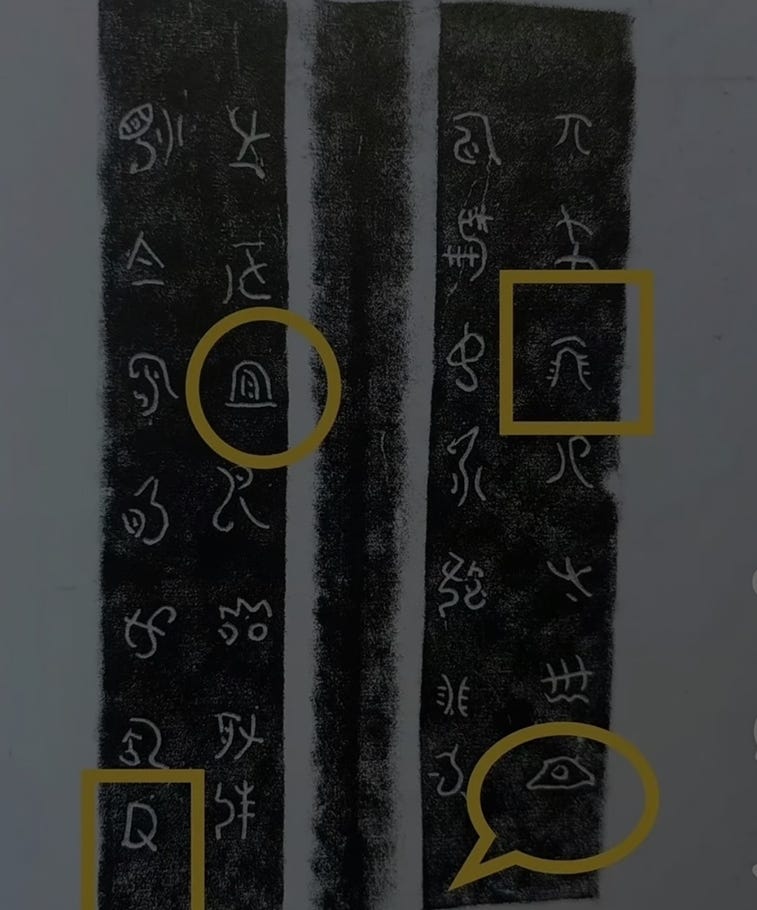
The peak of the Sanxingdui culture (三星堆) and the “new sacrificial pits” are generally dated to the twelfth–eleventh centuries B.C., that is, the late Shang (殷商晚期) to early Western Zhou (西周早期) period. By then the Central Plains (中原) already possessed two mature writing systems: oracle bone script (甲骨文) and bronze inscriptions (金文). Sanxingdui interacted frequently with the Central Plains, yet its aesthetics, divine images, and assemblages of objects formed a world of their own. In the published materials to date, Sanxingdui has not yielded continuous, “readable” strings of writing. Scattered incised marks, gold-foil symbols, and scratches on tooth and bone artifacts are limited in number and show low levels of repetition. Scholars mostly call them symbols, marks, patterns, or religious images rather than “readable writing.” This is the present consensus.
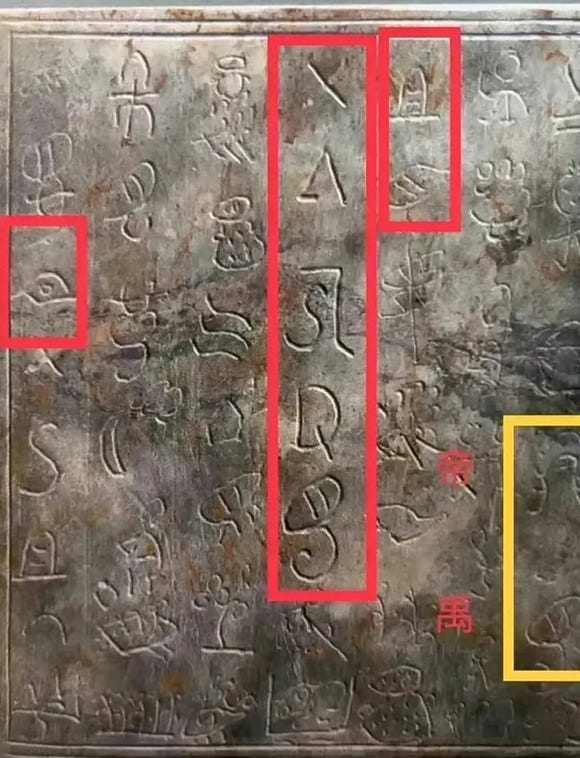
The three images at hand show a metal or stone surface dense with incised symbols; the video maker frames certain shapes that “look like letters” in red and yellow. Another image is a black-and-white strip in the style of a rubbing, likewise covered with lines. A third is clearer: it shows eye-shapes, triangles, arcs, spirals, forms resembling “∩,” “S,” “R,” as well as small images of birds, claws, and vessels. The question is straightforward: are these “writing”? Can one use them to push the history of Chinese writing back before oracle bone script?
To answer whether they are “writing” or “marks,” one must first fix the standard for writing. The basic consensus in graphemics is that “writing” uses repeatable symbols to stably record language. From this follow four tests: 1) repeatability—the same set of symbols recurs across different media; 2) sequencing—there is a direction of arrangement or fixed combinations rather than scattered decoration; 3) correspondence with sound or words—at least some symbols have a stable relation to pronunciation or meaning; 4) extent and context—there appear several “longer” strings, preferably matching the function implied by the findspot (record of events, accounting, ownership marks, etc.). Call these the “four-property test.” Any remains that cannot pass most of these are hard to recognize as “writing.” What follows applies this test, point by point, to what the images show, together with the basic archaeological situation at Sanxingdui and contemporaneous sites.
What the Images Can and Cannot Establish
Visible lines and shapes
The lines in the three images are mostly single incisions, of uniform width and sharp turns. Identifiable shapes include:
Geometric forms: triangles, trapezoids, half-rings, zigzags, ∩-forms, S-forms, R-like hooks;
Object/limb forms: images resembling an eye, a claw, a bird, a container;
Linear series: down the center of the third image there appears to be a vertical row of several symbols, while small animal and vessel images are scattered to the sides.
These are external facts of form and can be confirmed; but pronunciation, word meaning, and grammar cannot be confirmed from the images—that lies in the category of “cannot be determined.”Mode of arrangement
The central column is indeed ordered, but the symbols to left and right are scattered, interspersed with animals and vessels. Overall there is no clear grid of lines and columns, nor any sign of fixed word division or boundary markers. This falls short of mature, continuous writing.Provenance and authenticity of the symbols
The screenshots come from a short-video platform; there is no information on stratigraphy, object numbers, dimensions, materials, or pit assignments. One cannot identify the object or its date from screenshots alone. Academic caution requires stating this. From the images themselves, one may discuss whether they “look like writing” or “line up,” but one cannot thereby conclude what their “pronunciation” or “meaning” is, or that they are “certainly earlier than oracle bone script.” Any assertion would require the full backing of object studies and excavation records.
Running the “Four-Property Test” Point by Point
Repeatability: some shapes repeat, but the system is weak
Eye-shaped symbols can be seen in the images, and Sanxingdui indeed often features the motif of “eyes” and “brows.” Triangles, half-rings, and wavy lines also recur. This suggests a “repetition” of artisan marks, sacrificial marks, or pattern components. But what repeats is external form, not “characters carrying sound.” Without a cross-object, cross-pit, cross-period catalog and statistical comparison, it is hard to prove they are the same “character.”
Conclusion: partially passes, but the evidence points to repeated “image–decoration,” insufficient to support “repetition of writing.”Sequencing: locally ordered, no overall lines
The central vertical column in the third image looks most like writing; however, the many scattered images to either side blur any clear boundary of a “text field.” There is no stable line spacing, character spacing, or start–stop markers; the symbols lack combinatory rules (such as fixed “affix-like” pairings). More crucially, the images do not show whether the same object presents a consistent layout on different faces.
Conclusion: does not pass. What appears is a hybrid of “local linearity plus large areas of nonlinearity,” resembling “all-over ornament” more than “text.”Correspondence with sound/words: evidence absent
To show that the symbols “record language,” one needs stable clues to pronunciation, meaning, or grammar, such as: the same symbol having similar readings in different contexts; the same word expressed repeatedly by two or more symbols (allowing reconstruction of phono-semantic or compound principles); proper names of persons, places, or objects that can be directly matched to archaeological context.
The three images show no such evidence. The video frames certain symbols as “like the letters K, A, R, S,” which is to play a “similarity game” with modern eyes. The world has only so many simple geometric shapes; basic strokes in any civilization often “look alike.” Taking “looks like” for “is” commits a pareidolic fallacy; it is not decipherment.
Conclusion: does not pass. There is no empirical proof that these symbols are “attached to sound.”Extent and context: no long passages, function unclear
Oracle bones and bronzes are recognized as “writing” also because they contain continuous records that can be read as divinations, sacrifices, investitures, or casting inscriptions with clear purposes. In the published materials from Sanxingdui, no strings long enough to punctuate have been found, nor is there a multi-layered set of clues that would match “owner, clan emblem, record of events.” The co-presence of animals, vessels, and geometry in the images looks more like a composite of images and ornament.
Conclusion: does not pass. Extent is lacking, context is lacking.
Overall: there is a glimmer of hope on “repeatability,” but the other three properties are missing. On this basis, the evidence is far from sufficient to push the “history of writing” earlier than oracle bone script.
Comparison with Early Symbols at Home and Abroad: Similarity Is Not Writing
Versus Central-Plains “pottery marks and incised symbols”
The Jiahu (贾湖) incised signs six or seven millennia ago, and incisions on pottery from Liangzhu (良渚) and Dawenkou (大汶口), all display triangles, grids, crosses, and eye-forms. But they lack sequencing and phonetic evidence. The field identifies them as symbol systems or religious markers, not “writing.” Sanxingdui is closer to this situation.Versus the “early stages” of cuneiform and hieroglyphs
In Mesopotamia (两河) and Egypt, the path toward writing shows a clear chain from accounting tokens to pictographs to syllabicization, and is accompanied by large, continuous, statistically tractable corpora of tablets or inscriptions. Nothing comparable—“large quantity, one system, gradual evolution”—has yet been seen at Sanxingdui. With only scattered, highly varied marks, analogy is difficult.Versus Shang–Zhou clan emblems and identifiers
Bronzes of the Shang and Zhou often bear clan emblems—short sets of images or symbols marking identity, not texts. Some repeating figures at Sanxingdui may likewise be emblems or artisan marks. If so, they have social meaning, but are not writing.
Notes on Several Symbol Types in the Images
“Eye-shapes”: in keeping with the “protruding eyes” motif of Sanxingdui masks, possibly a religious symbol or aesthetic component. It is unknown whether they can be read as a word. “Triangles/half-rings/S-forms/∩-forms”: very common in global symbol inventories, possibly indicating partition, counting, ornament, or the result of toolwork. Their specific meanings are unknown. “R/K/A-like” shapes: resemblance is coincidental and cannot support claims of letter transmission or an indigenous alphabet. One cannot read “is” from “looks like.” Social media often shoehorn incisions into an “alphabet.” The reasons are clear: the brain prefers pareidolia, finding the familiar in random lines; simple geometry is highly cross-cultural and easily resembles modern letters; add the narrative of a “sensational discovery” and spread accelerates. In scholarship, one does not argue “is” from “looks like”; one argues from clear provenance, repeated confirmation, and readable context. Otherwise it is a story, not evidence. “Birds, claws, small vessels”: these look more like parts of image narrative or ornamental collage. Their relation to the central column is unknown. The central column: it is the most “writing-like” portion of the images, but the lines are short, interference from either side is heavy, and repetition is low. One cannot read characters from this alone.
Sanxingdui and the Origins of Chinese Characters: Nearer, Not Through
Pushing the history of Chinese characters earlier than oracle bone script is not absolutely impossible—the symbol systems of the Neolithic in the Central Plains and the Yangtze River basin do offer a possible horizon of “image—mark—writing.” But the archaeological timeline is clear: the earliest materials that can be read without dispute remain the late-Shang oracle bones; the lines of continuous evolution are the bronze inscriptions, the small seal, and clerical scripts; earlier pottery marks and bone incisions largely remain at the level of “marks and images.”
Sanxingdui may have possessed a local symbol system serving ritual, authority, craft, and exchange. What relationship did it have to Chinese characters? At present there is no direct evidence. There may have been mutual observation of ornamental styles; there may have been cross-regional conceptions of symbols. But to call it “the direct ancestor of Chinese characters” does not hold up as a chain of evidence.
If one wishes to upgrade the judgment from “symbols” to “writing,” at least the following are needed: 1) longer strings: continuous sequences of a dozen or two dozen symbols laid out in lines; 2) cross-object repetition: the same set of symbols appearing multiple times in different pits and on different objects, with repeated patterns of combination; 3) contextual anchors: matches with place-names, personal names, object names, or sacrificial terms drawn from archaeological facts; 4) evidence of writing techniques: dedicated writing tools, traces of erasure or correction, practice pieces; 5) statistical support: character-shape frequencies, collocational entropy, positional preferences showing a “language-like” pattern rather than random ornament. With these in hand, one can speak of “decipherment.” In their absence, the most prudent statement is: Sanxingdui has left an important system of symbols, which may encode religion, identity, or craft; whether it is writing is unknown.
Restoring Sanxingdui to Its Civilizational Significance
Even if not “writing,” the symbols of Sanxingdui remain important. They display a complex symbolic system supporting a powerful order of religion and authority. They may carry functions of identity and craft process (such as pairing, sequencing, partition). They allow us to see a polycentric Bronze Age in which different regions did not have to rely on “writing” as the sole instrument of governance. From this perspective, Sanxingdui and the oracle bones and bronzes of the Central Plains represent two parallel paths: one axis of writing—archive—record, and another axis of image—ritual—symbol. Both are genuine civilizational choices.
Returning to the initial question: can these few images be used to push the history of Chinese characters before the oracle bones?—At present, no. The reasons are clear: the images do not satisfy the “four-property test”; Sanxingdui has not published continuous, readable texts; compared with the evolutionary chains of “early writing” at home and abroad, key links are missing. This is not conservatism but responsibility to the evidence. Real breakthroughs depend not on “resemblance,” but on what can be verified, replicated, and statistically demonstrated. If, in the future, inscriptions of the same system are found at Sanxingdui or in Guanghan (广汉), of extended length and repeated across objects, and can be correlated with sacrificial terms or proper names, then it will be time to speak of a “writing system” with greater confidence. At that point, whether the “history of writing” can be pushed earlier will answer itself.
Until then, the most prudent conclusion is a single sentence: the symbols of Sanxingdui are important, but whether they are writing is unknown. They invite a different angle on early Chinese civilization: “writing” is not the only mode of self-expression. Images, ritual objects, craft, and symbols can also make up a fully effective social memory. To fixate on whether they “look like letters” is to miss what is most compelling about them.