

The Bill for Freedom
Zhang Ping (张平)
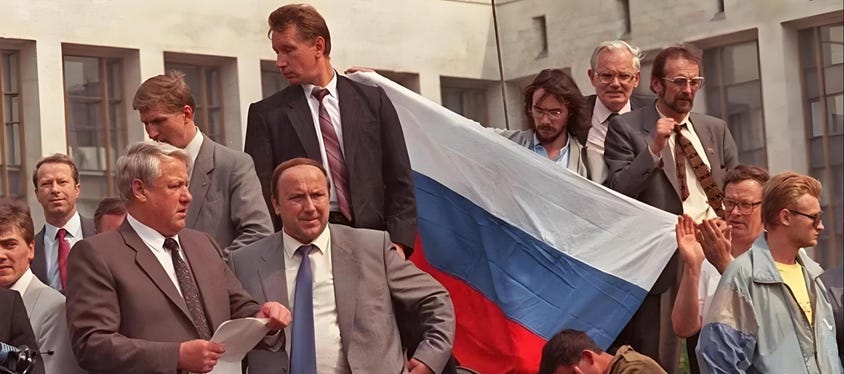
On the morning of August 19, 1991, Moscow Radio broadcast Tchaikovsky’s Swan Lake (天鹅湖)—the customary prelude to a political earthquake in the Soviet Union. Conservative hard-liners launched a coup and placed Gorbachev (戈尔巴乔夫) under house arrest. Yet three days later, the coup collapsed, and the photograph of Yeltsin (叶利钦) standing on a tank traveled around the world. In Dzerzhinsky Square (捷尔任斯基广场), the crowd fastened steel cables to the cast-iron statue of the founder of the KGB and pulled it down with a crash. The cheers shook the air.
No one asked: after freedom, what are we supposed to do?
In Secondhand Time (二手时间), Svetlana Alexievich (阿列克谢耶维奇) records a detail that is hard to forget. A Moscow intellectual woman who had lived through those ecstatic years recalled how, in the Soviet period, her generation secretly passed around samizdat in their kitchens and softly recited Mandelstam (曼德尔施塔姆). Out of samovars and cigarette smoke, they had smoked into being the soul of an entire generation of dissidents.
When freedom arrived, she wept. Then she discovered that she did not know what to do with it. She could speak about freedom. She could suffer for freedom. She could defend, at the cost of her life, the right to speak about freedom in a kitchen. But she had never learned how to manage freedom in daylight, in the public square, and before the ballot box. Years later, when Putin’s portrait was hanging on the wall again, she said something heartbreaking to the interviewer: perhaps we were never worthy of freedom.
That sentence is self-reproach, but it points to a severe question in political science: why did the Moscow kitchen fail?
The easy answers are everywhere. Yeltsin’s shock therapy destroyed the middle class. The oligarchs carved up state assets. Putin used the nationalist surge of the Chechen War to rebuild authoritarian power. All of this is true. But these are symptoms, not the root of the illness. The real root had already been diagnosed by Tocqueville (托克维尔) a century and a half earlier. No one wanted to prescribe that medicine, because it sounded too harsh.
In Democracy in America (论美国的民主), Tocqueville made a distinction that would prove deeply influential: institutions and mores. By mores, he meant “the whole moral and intellectual state of a people,” or “habits of the heart.” He stated plainly that, among all the factors deciding whether democracy could take root, geography mattered least, institutional design came in the middle, and mores mattered most.
He watched the French Revolution produce one constitution after another. He watched the same people kill under the banner of freedom and rebuild empire out of terror. From this he drew a conclusion that displeased the heirs of the Enlightenment: transplant American institutions onto a soil without American mores, and what you get will not be America. You will get the original destiny of that soil, merely dressed in democratic clothing.
Russia in 1991 was the perfect footnote to that prediction.
There was a constitution. There was separation of powers. There were multiparty elections. What was missing was the habit of local self-government built over centuries, the instinct of citizens to organize themselves, and the kind of mores that place “my rights” and “my responsibilities” in the same mind at the same time. The Moscow kitchen cultivated the passion to criticize, but not the capacity to govern. It taught people to hate despotism, but it did not teach them how to restrain one another, and answer to one another, when despotism was gone.
Freedom is a bill. It is not only a gift.
In the nineteen-nineties, more than a million Soviet Jews emigrated to Israel, and a considerable number of them came from the intellectual circles of Moscow and Leningrad. I know some of them. They were engineers, doctors, musicians, and also witnesses to that kitchen culture.
I once asked one of them how he had felt when the Soviet Union collapsed. He was silent for a moment, then said, “We thought freedom was the destination. Only after we arrived in Israel did we understand that freedom was the starting point—and a very exhausting one.”
He paused, and then added, “In the Soviet Union, you only had to resist. In a free place, you have to take responsibility. Resistance is easy. Responsibility is much harder.”
That sentence reveals the second dimension of the tragedy of the Moscow kitchen: the asymmetry between the benefits of freedom and the costs of freedom. What the dissidents in the kitchen longed for were the fruits of freedom: speech, movement, thought, and freedom from fear. That longing was entirely legitimate. But freedom also requires payment. It requires paying taxes, taking part, compromising, tolerating views you dislike, and accepting the outcome of an election even when you dislike the winner.
These costs were not discussed in the kitchen, because under despotism there was no place to practice them. Seventy years of Soviet training turned whole generations into masters of protest, but left them illiterate in the work of governance. One sentence in Alexievich’s book is like a nail driven into the wall; it cannot be pulled out: “No one taught us what freedom was. We were only taught how to sacrifice ourselves for freedom.”
To sacrifice oneself for freedom is a tragic and stirring passion. To enjoy freedom and pay its bill is a dull daily lesson. Russians learned the former. They lost their way before the latter.
History’s window never waits.
From 1991 to 1993, Russia had its last and most real chance at democratization. The window was open. The wind came in, and people felt a chill they had never felt before. It was fresh, and it made them dizzy. But on the other side of the window lay a field that had to be cultivated, not the fertile soil of mores that Tocqueville had found in America, already worked for two hundred years.
A wasteland needs farmers. What Russia had at that moment were poets, philosophers, and brave dissidents. What it badly lacked were citizens willing to bend down and till the soil.
Putin was not the cause. He was the result. He was what grew naturally out of that wasteland.
The Moscow kitchen talked into being the conscience of an age, but it could not talk a country’s future into existence. A country’s future, after all, is never made in a kitchen.
June 4, 2026
Tokyo
https://www.weibo.com/1645289855/R327IedFL