

Ren Jingjing
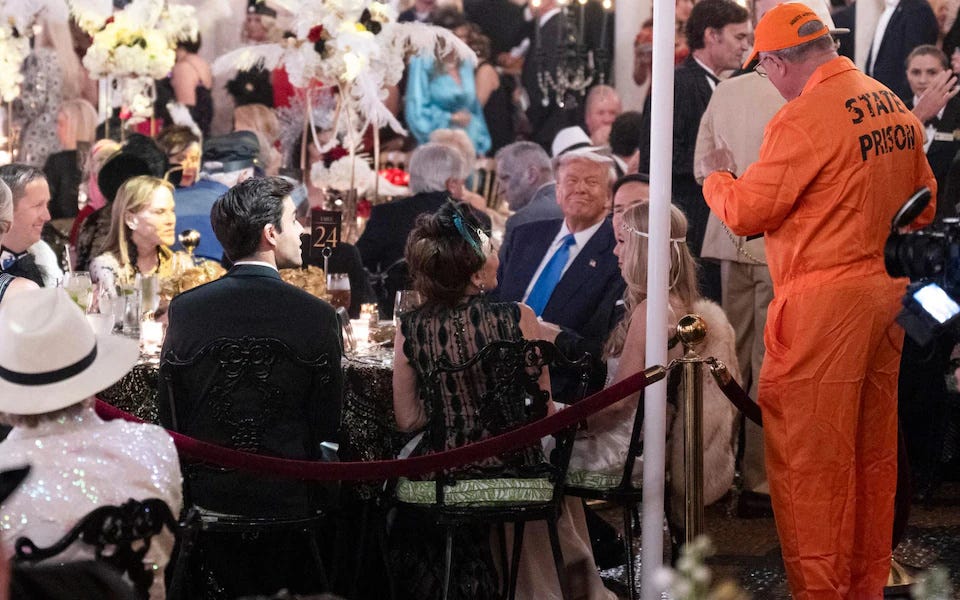
During Halloween, social media filled with clips from the lavish parties at the Mar-a-Lago estate (海湖庄园): night fell, gold chandeliers glittered above crossed glasses, a bikini-clad model reclined in an oversized champagne flute, dancers in red spun with smiles, the crowd applauded, toasted, and whooped. Outside, the world braced for storms; inside, laughter drowned out the music. Such scenes are now common online: privatized political parties, ritualized revelry, banquets centered on “leader and entourage.” Jianli’s (渐离) poem Mar-a-Lago (《海湖》) was written in this atmosphere. It uses the ancient four-character Book of Songs line to strike at the softest and most corrupt part of contemporary political life—the shamelessness and desire covered over by luxury and display.
A Moral Judgment Beating Like a Drum
The poem has four stanzas, each six lines, each line four characters. The rhythm is short, the phrasing regular, as if a single breath were held in the chest and each line struck. It opens with “Mar-a-Lago feasting / the Ji clan runs riot.” Space and subject are set at once: a manor that symbolizes wealth and power; a ruler sunk in private desire and performance. The lines “brings no good to the realm / brings no peace to the four quarters” repeat the negative “no,” building a pulse like drumbeats and giving the stanza the cadence of political judgment. It ends with “sycophants follow, clapping / is there prudence or virtue?”—placing the flatterer’s simper next to the ruler’s lack of character, so the stage’s merriment turns to moral desolation.
The second stanza—“Mar-a-Lago is foul / the Ji clan doubles its fault”—pulls back the gilded curtain. The noise continues; the air is already dirty. “Brings no good to the common people / brings no peace to home and state” sustains the first stanza’s structure and deepens the negation. “Gluttons’ mouths, greedy tongues / courtesans piping and singing” snaps the lens to a close-up: clinking cups, dances in bloom, every sense aroused—while government grinds to a halt, soldiers and civilians run out of rations, the nation struggles, the hungry suffer, all barred outside the gates of the Mar-a-Lago estate.
The third stanza turns to ethics: “The people toil indeed / a gentleman’s shame.” Borrowing an old line from “The Toils of the People” in the Book of Songs—Minor Odes, “Min Lao” (《诗经·小雅·民劳》)—the poet resets the definition of shame: when the people labor and the gentleman banquets, that is the greatest shame. Then come “the Ji clan is mediocre / robed retinues trail along,” a comic chain linking lord and attendants. “My heart burns / I dare not follow the crowd” is the poem’s only first-person confession. It is not a shout. It is a nail hammered in under pressure: to refuse the chorus is the courage of this moment.
The last stanza rises to history and the order of Heaven: “Draw the bow, draw it hard / states have their bounds,” a martial image for a moral limit, a reminder that power must contain itself. “The tyrant never has enough” names the root of turmoil. “The lessons of Yin are close at hand / the people speak no praise / vast Heaven dawns day after day” brings a triple closure, weighing the charge on the scales of history and Heaven. The banquet lights have not gone out, but the poem’s voice has turned to stone, carved into the conscience of civilization.
The Poem’s Imagery and Moral Progression
“Mar-a-Lago” is a place in the world and a political emblem. It names a private luxury and hints at a climate of politics drowned in private desire. Beneath the shimmer is ethical decline; beneath the applause, institutional slippage. The poet pairs “banquet” with “filth,” letting fragrance and rot coexist, light and stain share the same frame.
“Ji clan” (季氏) comes from the “Ji Shi” chapter of the Analects (《论语·季氏》): a byword for the minister who usurps ritual and spoils order. The poem uses the name to indict not only a person but a structure of complicity—virtue does not match the office, and office does not seek virtue; power turns into a tool of consumption and entertainment. “The people toil indeed” pulls the poem back to the real: ordinary people labor without end, yet are reduced to background noise in the distance. “The lessons of Yin are close at hand” and “vast Heaven dawns day after day” lift the party beyond the news cycle and into history’s mirror—humanity always seems to hold a feast as if at a rite, dancing its last dance before collapse.
The imagery is tiered: banquet → state and home → history → Heaven. Each turn deepens the critique: from extravagance to disorder, from disorder to shame, from shame to warning, from warning to law. With the fewest words, the poem completes an ascent in political ethics.
I Hear the Echo of “Big Rat” (《硕鼠》)
“Big Rat” (《硕鼠》) is among the sharpest protests in the Book of Songs, the anger of the deprived—“Big rat, big rat, do not eat my millet.” The rat stands for the greed of rulers. It ends with “We shall go away,” that is, departure, leaving the order of exploitation. Jianli’s Mar-a-Lago inherits this critical spirit but reverses the direction—from leaving to standing, from “go away” to “do not follow.” The difference marks a change of times. In “Big Rat,” the powerless accuse. In Mar-a-Lago, the discerning must set limits. The former calls for exit; the latter demands standing one’s ground. The former speaks of unjust distribution; the latter, of breached boundaries. With “a gentleman’s shame,” the poet reminds modern society: when wealth and power merge, the first thing to vanish is not morality but shame. The collapse of shame means the threshold of civilization has been crossed.
In rhetoric, Mar-a-Lago is closer to an inscription than a song. There is no thicket of metaphor, only the force of declarative lines; no soft sighs, only the cadence of judgment. Compared with the “hot satire” of “Big Rat,” Mar-a-Lago is “cold judgment”—cold as a verdict, its restraint giving it greater bite. It restores to poetry a public function: not ornament, but measure.
In form, Jianli returns to the Book of Songs; in spirit, he turns to the present. With “simplicity,” he cuts away all excess. With “force,” he drives the tightening pace. With “directness,” he strikes at the core of judgment. Adjectives are scarce; nouns and verbs clash head-on. The chill of the language throws into relief the heat of the moral claim. “Sycophants follow, clapping” stands against “my heart burns”: the former is a portrait of fawning, the latter the clarity of conscience. “The lessons of Yin are close at hand / vast Heaven dawns day after day” sets history beside Heaven’s order. It is both a political warning and a philosophical end point. At that height, the poem is not only critique; it is civilization’s self-examination: why do we reenact our fall at the banquet table, again and again?
When Luxury Replaces Morality, When Applause Replaces Shame
The real images—giant champagne flutes, dancers in red, the laughter of politicians and tycoons—are footnotes to Mar-a-Lago. The scenes are familiar: in antiquity, the Deer Terrace of King Zhou of Shang (鹿台); in the Han, Shi Chong’s Jingu Garden (石崇·金谷园); today, the Mar-a-Lago estate. The form of the feast changes; the spirit of corruption runs unbroken.
“Sycophants follow, clapping” is almost film language—the applause becomes currency, the smile, coin. “Robed retinues trail along” captures the power ecology of the present: surface ceremony replaces inner cultivation. “States have their bounds” is pointed today. It names not only national borders but institutional ones. In any system, power without self-restraint breaks the civilization it rests on. The banquet shocks not for its luxury but for the self-regard of power it puts on display: against a backdrop of national crisis because of the government shutdown a nd domestic hardship, millions of service members and federal civil servants, unpaid, stood in the wind and rain for free dinners; tens of millions of the widowed and solitary, the elderly, the frail, and the disabled lost the foodstamp they live on the very next day; and yet the nation’s head of state spent Halloween night at Mar-a-Lago (海湖), cavorting with ghouls and goblins, singing and dancing, laughing for his own amusement. This numbness to real suffering is a sign of political ethics in collapse. The shame of Mar-a-Lago is the shame of America.
The poem’s deepest lesson is not anger but measure. True civilization is not the absence of desire; it is knowing when to stop. It is not the absence of applause; it is the refusal of applause that should never be given. First, shame is the foundation of order. When those in power delight in luxury and conformists pride themselves on applause, society enters a “shameless” phase. Shamelessness is a deeper corruption—it no longer pretends. Second, boundaries are civilization. “States have their bounds” is not only a line of defense toward others; it is the sign of self-restraint. A system that loses a sense of boundary becomes a stage for performance. Third, virtue must match office. “The Ji clan is mediocre / robed retinues trail along” exposes hollow politics—form on the outside, no spirit within. Fourth, not following the crowd is a virtue. “My heart burns / I dare not follow the crowd” looks slight, yet it is the rarest courage in modern life. It recalls the Analects: “If all hate him, examine it; if all love him, examine it.” Moral clarity often begins with refusing applause.
There Is No Banquet That Never Ends
Jianli’s Mar-a-Lago shows that a classical form can still speak a present truth. The four-character beat sits like an inscription in the reader’s mind—a bell from within civilization: when “the tyrant never has enough,” take “the lessons of Yin” as mirror; when “sycophants follow, clapping,” take “not following the crowd” as warning; when the night is darkest, trust that “vast Heaven dawns day after day.” As Xiao Hong (小红) says in Dream of the Red Chamber (《红楼梦》), “You can build a long shed for a thousand li, but there is no banquet that never ends.” When the feast breaks up, we learn whose suit hides a prison uniform.
Mar-a-Lago is not a news poem. It is a documentary poem of civilization. With an ancient form, it interrogates the modern. With spare language, it tears off the gilded mask. The real-world party may be a holiday spree. In the poem’s mirror, it returns to history’s cycle: from the “wine pools and meat forests” under King Zhou of Shang to the public baths of Rome, from Shi Chong’s Jingu Garden to today’s Mar-a-Lago, human extravagance and the loss of shame always begin with a feast; a politics centered on private desire and the rot of power always makes a stage of women’s bodies. When crisis surrounds us and the powerful still drown in drink and song, luxury is not a flourish; it is the omen of political decay and disaster. A manor paved with gold is a bell tolling before a polity collapses. The long history of ostentatious rule says this: when power loses its self-limits, when pleasure covers moral sense, when the extravagant banquet becomes politics’ daily routine, the end of splendor is already on its way.
Mar-a-Lago feasting
the Ji clan runs riot
brings no good to the realm
brings no peace to the four quarters
sycophants follow, clapping
Is there prudence or virtue?
Mar-a-Lago is foul
the Ji clan doubles its fault
brings no good to the common people
brings no peace to home and state
gluttons’ mouths, greedy tongues
courtesans piping and singing
The people toil indeed
a gentleman’s shame
the Ji clan is mediocre
robed retinues trail along
my heart burns
I dare not follow the crowd
Draw the bow, draw it hard
states have their bounds
the tyrant never has enough
the lessons of Yin are close at hand
the people offer no praise
vast Heaven dawns day after day
— “Mar-a-Lago” (《海湖》) by Jianli (渐离)
海湖宴飨
季氏放荡
莫惠其邦
莫绥四方
诡随抚掌
岂谨无良?
海湖龌龊
季氏贰过
莫惠庶人
莫绥家国
饕口馋舌
商女笙歌
民亦劳止
君子之耻
季氏庸庸
衣冠扈从
我心如焚
不敢从众
挽弓挽强
列国有疆
独夫无厌
殷鉴不远
民言无嘉
昊天旦旦
—《海湖》渐离
Excellent commentary. Would it be possible to post the original 古汉语 text in full ? Interestingly, Gao Jianli 高渐离(the putative author of the poem analyzed here) was a close friend of Jing Ke 荆轲, the failed assassin of Qin Shihuangdi (秦始皇帝, the First Emperor of Qin) who was widely perceived as a tyrant. Gao was himself a renowned musician, whose fame eventually led to his being hired as an entertainer at the Qin Emperor’s court; he too attempted to assassinate the Emperor to avenge the execution of his friend Jing Ke, but failed and was executed in his turn.